Essence of Life - Food
  • Home
  • From My Kitchen
    • Heirloom Recipes
    • From God's Own Country
    • Sadhya
    • Kongu Cuisine
    • Chettinaad Cuisine
    • South East Asian
    • Around the World
  • Ebook
  • I Me Myself


      Another Sundal recipe to follow the suit - a simple Sundal prepared with Groundnut/Peanut. Pre-soaked & cooked Groundnut/Peanut with a note of mild tempering made with Mustard Seeds, Urad Dhal, Curry Leaves, Dry Red Chillies, grated Coconut and a pinch of Asafoetida is a delicacy on its own.  Sundal Recipe serves the purpose as a Side Dish for lunch, as a simple & healthy Evening Snack, also it is served as a Naivedhyam/Prasadham during Navratri Festival/Vinayaga Chathurthi/Krishna Jayanthi.
     Sundal can be prepared with White/Black Chick Peas, Green Gram Dhal, Moong Dhal, Peanuts/Groundnuts, Green Peas, White Cow Peas, Red Beans, Kidney Beans/Rajma, Bengal Gram Dhal, Kollu/Horse gram, etc., Though the basic recipe serves the same, only the soaking & cooking time varies with each Beans, Lentils & Pulses.
     This Sundal Recipe is prepared with Groundnut/Peanut.  I usually soak the Groundnut/Peanut overnight. Drain the water used for soaking and then cook the Groundnut/Peanut in a Pressure cooker until it turns soft.  If you are serving the Sundal recipe as a Naivedhyam/Prasadham, avoid adding Onions.
 

For more SUNDAL RECIPES, Click here...

Course - Side Dish
Spice Level - Moderate
Difficulty - Easy
Serve - 3-4
Author - SM

Preparation Time - 5 -10 Minutes
Soaking Time - 8-10 Hours/Overnight
Cooking Time - 25 - 30 Minutes

HOW TO COOK KONDAIKADALAI SUNDAL / BLACK CHICKPEAS SUNDAL


INGREDIENTS :

To Soak & Cook

Groundnut/Peanut - 1/2 Cup
Water - 2 Cups

For Tempering :

Oil - 2 Tbpsn
Mustard Seeds - 1 Tspn
Black Gram Dhal/Urad Dhal - 1 Tspn
Dry Red Chillies - 2 Nos.
Curry Leaves - 2 Sprigs
Asafoetida - a Pinch
Grated Coconut - 2-3 Tbpsn


For detailed recipe on HOW TO COOK BEANS, LENTILS & PULSES, click here...

METHOD :

To Soak & Cook Groundnut/Peanut :

  • Clean, Wash and Soak Groundnut/Peanut overnight or for at least 8-10 hours.
  • Alternatively can soak the Groundnut/Peanut in Boiling Water for 3-5 Hours.
  • Once soaked, drain the water used for soaking.
  • Add 2 Cups of Water to the Groundnut/Peanut & Pressure cook.
  • Pressure cook on high flame for 2 whistles, reduce the flame and cook for other 4-5 whistles.
  • Adjust the cooking time to suit your cooking preference.
  • Once cooked drain any excess water from the cooked Groundnut/Peanut.

For Groundnut/Peanut Sundal :

  • Heat Oil in a Pan.
  • Splutter Mustard Seeds, Black Gram Dhal, Dry Red Chillies & Curry Leaves in it.
  • Add Asafoetida Powder to the above and give a quick stir.
  • Immediately add grated Coconut and fry for a while.
  • Add cooked Groundnut/Peanut along with a dash of Salt.
  • Cook this on a very low flame for few minutes until all the ingredients are well incorporated.
  • Serve Groundnut/Peanut Sundal hot or cold.
  • Can be served as a side dish, evening snack or can be served as a Naivedhyam/Prasadham.

NOTES :

  • Do not add Salt while cooking the Groundnut/Peanut.
  • Can prepare the same recipe with Black Chick Peas, White Chick Peas, Green Gram Dhal, Moong Dhal, Green Peas, White Cow Peas, Red Beans, Kidney Bean/Rajma, Bengal Gram Dhal, Kollu/Horse gram etc.,
  • Though the basic recipe serves the same, only the soaking & cooking time varies with each Beans, Lentils & Pulses.

MANGA CURRY, SADHYA, ANGAMALY
ANGAMALY MANGA CURRY - RAW MANGO CURRY WITH COCONUT MILK


     A few months back while I was watching a Malayalam Movie - Cuban Colony, I came across with a wonderful recipe prepared with Raw Mangoes. A regional delicacy of Angamaly- Angamaly Manga Curry. Angamaly is a place near Cochin in Kerala. They had showcased about this Curry as a Song in the movie. The song starts with the line - "Angamaly Manga Curry Kandodi Mole."  The song itself teaches how the Curry has to be prepared in an elaborate way. Preparing the so-called delicacy as a group task(commonly all-men group) for a wedding banquet, particularly served for dinner prior to the Wedding Day. Referred as a must serve item in Sadhyas/Banquets in Angamaly region.  If Pork is one item the people of Angamaly love, then this Angamaly Manga Curry follows the suit.
     The group preparation of Sadhya Items for a wedding reminded me of my childhood days. Those were the days when Catering was not quite so prevalent.  The Cooking scenario for the big day begins by procuring vegetables for the Sahdya.  Some vegetables would also be sourced out from neighbour's farm.  Then comes sourcing out the massive Vats for preparing the delicacies - huge Urulis, Charakku, Ladles, Woks, Cherava(Coconut grater), Utensils etc., from the neighbourhood.  The scene of the evening before the Wedding day would be like all men gathered around in the cooking area. Most of the cooking is done by the members of the family, relatives and from the neighbourhood - but commonly men carry the show when it comes to such events. A head cook assigned for the occasion delegates the jobs.  The scenario starts along with, grating the Coconuts. A Kerala Sadhya without Coconut - unimaginable!  Then cutting the vegetables, grinding the masala, extracting Coconut Milk etc., & etc., All happens around with a whole lot of fun, laughter, gossips, and least to mention the MINUNGAL PARIPADI (silently sneaking out for Drinks).  And by early in the morning the items for Sadhya gets ready one by one. Mostly the first thing which gets ready would be the Payasam/Pradhaman.  Hot cups of (Choodu)Payasam catered immediately around in the name of tasting is one thing the whole group anticipates.
   The movie instantly reminded me of the above incidents and all the more, I was instantly impressed by the legend of this Angamaly Manga Curry. Then a recipe with Mango should never be missed. I searched through the internet and here goes the recipe for Angamaly Manga Curry.  I felt that this curry quite similar to a common recipe we prepare at home - "Chemmeen Manga Curry" which is my MIL's speciality.  This curry is a version without Prawns. But the trick behind that tasty Angamaly Manga Curry is the hand-crushed ingredients along with Coconut Oil which makes the curry more flavourful & tasty. Crushing the ingredients using the hands brings our the essential oils reacting along with the body heat, which makes this Angamaly Manga Curry unique.


For more CURRY RECIPES, Click here...


Cuisine - Angamaly, Kerala(South India)
Recipe Type - Curry
Spice Level - Medium-High
Difficulty - Easy

Serves - 4
Author - SM


Preparation Time - 15-20 Minutes
Cooking Time - 15-20 Minutes 


HOW TO MAKE ANGAMALY MANGA CURRY - RAW MANGO CURRY WITH COCONUT MILK


MANGA CURRY, SADHYA, ANGAMALY
ANGAMALY MANGA CURRY - RAW MANGO CURRY WITH COCONUT MILK


INGREDIENTS :

For Angamaly Manga Curry :

Raw Mango - 2-3 Medium Sized Mangoes

To Crush(using Hands):

Shallots - 5-6 Nos.
Green Chillies - 5-6 Nos.
Ginger - 1/2" Piece
Curry Leaves - 2 Sprigs
Turmeric Powder - 1/4 Tspn
Red Chilli Powder - 1/2 Tspn
Coriander Powder - 1 Tspn
Coconut Oil - 1-2 Tspn
Vinegar - 1- 2 Tspn
Thick Coconut Milk -  1/2 Cup
Thin Coconut Milk - 1 Cup
Salt - To Taste

For Tempering :

Coconut Oil - 1 Tbspn
Mustard Seeds - 1/2 Tspn
Fenugreek Seeds - 1/4 Tspn
Shallots - 3-4 Nos.
Curry Leaves - 1 Sprig.

METHOD :


  • Peel, cut and discard the seed from the Mango, cut it into pieces & keep it aside.
  • Finely chop Shallots, Ginger & slit Green Chillies into two.
  • Add the above ingredients into an Earthen Pot/Pan along with Curry Leaves.
  • Gently crush the ingredients using your hand, mix it thoroughly for a few minutes until the ingredients seem to be well crushed.
  • Add Turmeric Powder, Red Chilli Powder, Coriander Powder along with a dash of Salt to the crushed ingredients.
  • Pour the Coconut Oil to the above and gently crush the ingredients using your hands.  
  • Mix it thoroughly for a few minutes.
  • Pour in the Vinegar to the Masala and again mix all the ingredients. 
  • Once all the ingredients are well incorporated, the Masala for the Manga Curry is ready.
  • Pour in the Thin Coconut Milk and mix it again.
  • The Masala should get evenly mixed along with the Coconut Milk.
  • Now add Mango Pieces to the Manga Curry mixture.
  • Now you have to mix it carefully, gently swirl it using your hand(just clockwise).
  • Add enough Thin Coconut Milk so that it covers the ingredients.
  • Switch on the flame and place the Earthen Pot/Pan over it.
  • Cook the Angamaly Manga Curry on a medium flame.
  • Cook until the Mango Pieces turn soft and cooked(it shouldn't be overcooked).
  • Gently stir the Curry at regular intervals, otherwise, the Coconut Milk may get curdled.
  • Now Pour the Thick Coconut Milk and cook the Angamaly Manga Curry on a very low flame for a minute or two.  
  • Gently swirl the Pan at intervals at this stage.
  • Switch off the flame and leave the Angamaly Manga Curry aside.
  • Meanwhile, heat Coconut Oil in a Pan, splutter Mustard Seeds & Fenugreek Seeds.
  • Add finely chopped Shallots and Curry Leaves to the above and saute until shallots turn into light brown in colour.
  • Pour the Tempering over to the Angamaly Manga Curry and mix it gently.
  • Serve Angamaly Manga Curry/Raw Mango Curry with Coconut Milk along with Kerala Matta Rice or Steamed Rice.

For a detailed recipe on HOW TO MAKE COCONUT MILK, Click here...


MANGA CURRY, SADHYA, ANGAMALY
ANGAMALY MANGA CURRY - RAW MANGO CURRY WITH COCONUT MILK


NOTES :

  • Adjust the number of Green Chillies and the amount of Red Chilli Powder to suit your spice level.
  • We love spicy curries at home and as the curry should be in bright yellow colour, I have used more Green Chillies and a bit of Red Chilli Powder to spice up this Angamaly Manga Curry.
  • Fresh home-made Coconut Milk adds more flavour and taste to the Curry.
  • Cut Mangoes into the desired size.
  • Care should be taken while cooking the Mangoes, cooked Mangoes tend to get mashed up if you mix the curry with a ladle.  
  • So while cooking the curry mix the ingredients by swirling the pan.
  • If the Mango is not sour enough, can add an extra bit of Vinegar to add sourness to the curry.
  • Crushing the ingredients using the hand gives a unique taste and flavour to the curry.
  • Once the Angamaly Manga Curry is cooked, leave it aside for at least 2-3 hours so that the taste and flavours get well infused into the Curry.


RICE DISHES, PACKAGED LUNCH, POTHI CHORU
KANYAKUMARI KATTU CHORU

     Cape Comorin - Kumari Munai commonly called as Kanyakumari is a beautiful place in the Southern most part of India.  It rests at a point where Arabian Ocean, Bay of Bengal and the Indian Ocean meets.  It is one place where we can see both Sunrise and Sunset.  My childhood memories of travelling to Kanyakumari is still afresh with certain food items, particularly Kadhali Pazham, Matti Pazham, Kazhani Chakka, Mundhiri Kothu etc.,  I still couldn't forget the taste of Matti Pazham a small-sized Banana which I have never eaten since then anywhere else.
     The  Coastal district of Kanyakumari has a wide cultural influence from both Kerala and Tamilnadu.  Even the cuisine reflects the same, flaunting a wide range of Kerala and Tamil Nadu recipes.  This Kattu Choru is an authentic recipe from the region prepared & packaged traditionally.
     One weekend my husband said he wanted some variety rice to go along with Paruppu Vadai & Uzhundhu Vadai, which we usually buy at Pasar Malam, Saturday Night Market in our neighbourhood.  I decided to go along with Tomato Rice, and then he came up with this recipe from a YouTube Channel - Manchatti Kitchen.  It was a simple, easy to follow recipe and I thought it would taste somewhat like Puli Sadham(Tamarind Rice).  The method of cooking was quite traditional with all the more of a selling point - it was a Packaged Lunch wrapped in a Banana Leaf.  I love food served/wrapped in a Banana Leaf.  It imparts a wonderful smell to the dishes.
     This Kanyakumari Kattu Choru is served along with a simple Coconut Thogayal. This Kattu Choru which literally means packed rice is an utter treat when packed in a softened Banana Leaf. This simple Rice suits well for a weekday lunch also suits best for Lunch Box packing for school/office or while travelling.  For a literal traditional feel, pack it in a Banana Leaf. This Kattu Choru can be served along with your choice of Thogayal/Chammanthi, Fried Fish, Omelette or any Poriyal of your choice. Simple Potato Poriyal/ Potato Fry/Potato Roast goes hand-in-hand with it.  Or simply serve it with a smidgen of Pickle and crunchy appetizers like Appalam/Pappadam or Vadagam.


Cuisine - Kanyakumari (Tamil Nadu, South India)
Course - Main
Spice Level - Medium
Difficulty - Easy
Serves - 3- 4
Author - SM

Preparation Time - 10-15 Minutes
Cooking Time - 30-45 Minutes

For more Recipes on RICE DISHES, Click here...


COCONUT THOGAYAL FOR KANYAKUMARI KATTU CHORU


PACKAGED LUNCH, POTHI CHORU, KATTU CHORU
COCONUT THOGAYAL FOR KANYAKUMARI KATTU CHORU


INGREDIENTS:

For Coconut Thogayal:

Coconut -1/2 Cup
Shallots - 2 No's.
Cumin Seeds - 1/2 Teaspoon
Red Chilli Powder - 1 Teaspoon
Salt - To Taste

For Tempering:

Coconut Oil - 1 Teaspoon
Mustard Seeds - 1/4 Teaspoon
Curry Leaves - a Sprig

METHOD :

For Coconut Thogayal :

  • Grind the ingredients mentioned under "For Coconut Thogayal" coarsely.
  • Heat Coconut Oil in a Pan.
  • Splutter Mustard Seeds and Curry Leaves. 
  • Add the coarsely ground Coconut Thogayal mix to the tempering.
  • Fry this on a very low flame until the Coconut Thogayal turns dry and aromatic.

HOW TO COOK KANYAKUMARI KATTU CHORU


RICE DISHES, PACKAGED LUNCH, POTHI CHORU
KANYAKUMARI KATTU CHORU

INGREDIENTS :

Par-boiled Rice - 1 Cup
Shallots - 6 No's.
Dry Red Chillies - 2 No's.
Tamarind - 1 Lime Size
Gingelly/Sesame Oil - 2-3 Tablespoons
Curry Leaves - 2 Sprigs
Asafoetida -1/4 Teaspoon
Turmeric Powder - 1/2 Teaspoon
Salt - To Taste

METHOD:

How to cook Rice:

  • Clean, Wash and cook Par-boiled Rice.
  • Allow the rice to slightly cool down

For a detailed Recipe on HOW TO COOK PAR-BOILED RICE, Click here...

For Kanyakumari Kattu Choru :

  • Roast the Shallots on a direct flame until the skin burns.
  • Roast the Dry Chillies on a direct flame until it fluffs-ups and gets slightly charred.
  • Peel the Shallots and keep it aside.
  • Soak Tamarind in Water and extract tamarind juice out of it.
  • Crush the roasted Shallots and Dry Red Chillies in the Tamarind Juice with your hand.
  • Squeeze and crush until the shallots & dry chillies gets well mixed with the tamarind extract.
  • Keep the Tamarind Mix aside.
  • Meanwhile, heat Sesame Oil in a Pan or an earthen pot.
  • Add Curry Leaves and fry for a while.
  • Lower the flame, add Asafoetida Powder and give a quick stir.
  • Immediately, pour in the Tamarind mix.
  • Add Turmeric Powder along with a dash of Salt and allow the mixture to boil on a medium-low flame for a few minutes.
  • Cook until the raw flavour goes and oil separates from the mix.
  • Add Cooked Par-boiled Rice and mix well.

NOTES :

  • I have used Par-boiled Rice in this recipe.  Can also cook this recipe with Raw Rice.
  • Cook the rice accordingly.
  • Care should be taken while roasting the Shallots and Dry Chillies on a direct flame.
  • Adjust the number of Dry Red Chillies to suit your spice level.


HOW TO PACK KANYAKUMARI KATTU CHORU


Once the dishes are ready,

  • Wash the Banana Leaves, slightly slice off the Centre Rib of the Banana Leaf from beneath.
  • Carefully burn the Banana Leaves on Direct Flame.
  • Keep the Banana Leaf over the flame, the idea is to just wilt off the Leaf and not burn it up.
  • This way, the Leaf becomes easy to handle and doesn't break while packaging the lunch.
  • Spread a Newspaper or Packing Paper beneath.
  • Place the burnt Banana Leaf over it.
  • I have just packaged the Rice and the Coconut Thogayal in this Kanyakumari Kattu Choru menu.
  • Serve Kanyakumari Kattu Choru at the centre of the Leaf.
  • Serve a spoonful of Coconut Thogayal alongside.
  • If serving other dishes like Fish fry, Poriyal, Omelette etc., then...
  • Place a piece of Fish Fry over one corner of the Rice.
  • Follow the suit with a smidgen of Pickle and few tablespoons of Poriyal of your choice
  • Place the Omelette alongside.
  • Once all the dishes are served close around the Kattu Choru, carefully fold the burnt Banana Leaves.
  • Fold the Banana Leaves from all the four sides and tightly tuck it in. 
  • This will look like a packet on its own.
  • Now, Cover the Newspaper/Packing Paper over the Kattu Choru Packet.
  • Tightly secure it with a Kitchen Twine/Vazha Naaru(thread from Banana Tree).
  • Kanyakumari Kattu Choru is ready to be served - An eco-friendly Packaged Lunch.


     Once you open the Kanyakumari Kattu Choru, maybe after a few hours of Packaging, trust me the aroma of the dishes along with the burnt Banana Leaf is an experience to indulge in. A combined aroma of fresh homemade food prepared in a traditional way appeases your senses, increasing your appetite. Even if you are not packing it for a purpose(travelling, office/school), just prepare it likewise for lunch at home and serve it as such. (That's how I usually do at home). I prepare packaged lunches like Kanyakumari Kattu Choru, Pothi Choru etc., for lunch at home.  I pack it up at least 2-3 hours before lunchtime so that the taste, flavour & essence get imparted into the Rice, that way we can cherish the real flavour and get the literal feel of a packaged lunch.


CHUTNEY, TOMATO
TOMATO & CORIANDER CHUTNEY
  
      This Tomato & Coriander Chutney is a simple, easy to cook and all the more aromatic Chutney which goes along with Idli, Dosa, Uthappam, Paniyaram etc., This is a recipe which I adapted from the YouTube Channel - "Recipes in my Way".  My husband who came across this video said, the Chutney looks good and asked me to give it a try.
     Along with Sautéed Onions, Garlic, Tomato and Coriander leaves, the recipe calls for adding dry roasted & coarsely ground Coriander Seeds and White Sesame Seeds. It was the first time I was adding Sesame Seeds in any chutney. The cook insists upon adding this dry Roasted White Sesame Seeds in the chutney. Absolutely this particular ingredient adds a wonderful aroma to this Tomato Coriander Chutney.  The Chutney is equally spicy, tangy and has a wonderful flavour from the ingredients added into it.

Cuisine - South India 
Recipe Type - Condiment
Spice Level - Medium-High
Difficulty - Easy
Serves - 5
Author - SM

Preparation Time - 5 Minutes
Cooking Time - 10-15 Minutes


For more Recipes on CHUTNEYS & CONDIMENTS, Click here...


HOW TO COOK TOMATO & CORIANDER CHUTNEY


INGREDIENTS :


To Dry Roast & Grind :

Coriander Seeds - 2 Tablespoons
White Sesame Seeds - 2 Tablespoons

For Tomato & Coriander Chutney :

Oil - 2 Teaspoons
Mustards Seeds - 1//2 Teaspoon
Black Gram Dhal/Urad Dhal - 1 Tablespoon
Bengal Gram Dhal - 1 Tablespoon
Dry Red Chillies - 5 Nos.
Garlic - 10 Cloves
Onion - 1 No
Tomato - 5 Nos.
Tamarind - 1/2 Teaspoon
Turmeric Powder - 1/2 Teaspoon
Coriander Leaves - 2 Cups
Salt - To Taste

METHOD:

To Dry Roast & Grind :

  • Dry Roast Coriander Seeds on medium-low flame until aromatic.
  • Add White Sesame Seeds and dry roast it on a very low flame until the seeds splutter.
  • Care should be taken while roasting the above ingredients.
  • Dry roast the ingredients on a low flame.
  • Do not burn the ingredients.  
  • The colour of the Sesame Seeds should be White/slightly yellow.
  • If it browns or darkens, it will totally spoil the taste of the Chutney.
  • Cool the dry roasted ingredients and grind it into a coarse powder.
  • While grinding the ingredients, grind it in quick brief movements.
  • Whisk the mixer for few seconds, switch it off and then again follow the suit until the ingredients are ground in a coarse mixture,
  • If you grind it in swift continuous movements, the oil from the Sesame Seeds may make the mixture into a paste.
  • Keep the ingredients aside.

For Tomato & Coriander Chutney :

  • Heat oil in a Pan, splutter Mustard Seeds on a medium flame.
  • Add Black Gram Dhal/Urad Dhal & Bengal Gram Dhal to the above and fry on a very low flame for few minutes.
  • The Dhals should turn into a golden yellow colour.
  • Do not burn the ingredients which will alter the taste of the chutney.
  • Add Dry Red Chillies and fry until it fluffs up.
  • Sauté Garlic Cloves along with the above ingredients until aromatic.
  • Add chopped Onions and sauté until onions turn translucent.
  • Add chopped Tomatoes along with a dash of Tamarind.
  • Sprinkle 1/2 a Teaspoon of Salt and sauté it for a while on a medium flame.
  • Add salt and give a quick stir.
  • Lower the flame, cover and cook for about 5 minutes or until the tomatoes are well cooked.
  • Add finely chopped Coriander Leaves to the above and cook for few seconds(until it wilts).
  • Add the coarsely ground mixture and give a quick stir.
  • Allow the Tomato & Coriander Chutney mixture to cool.
  • Grind the ingredients to a smooth paste.
  • Serve Tomato & Coriander Chutney along with Idli, Dosa, Uthappam, Paniyaram etc.,

NOTES :

  • Adjust the number of Dry Red Chillies to suit your spice level.
  • I have used normal Tomatoes in the recipes which are not tangy.
  • So I added a dash of Tamarind for the required tanginess in this Chutney.
  • If you are using Local Tomatoes/Nattu Thakkali can skip adding Tamarind or adjust accordingly.
  • Dry roast the Coriander Seeds and Sesame Seeds on a low flame.
  • Do not burn the ingredients.  
  • The colour of the Sesame Seeds should be White/slightly yellow.
  • If it browns or darkens, it will totally spoil the taste of the Chutney.
  • Cool the dry roasted ingredients and grind it into a coarse powder.
TIFFIN ITEMS, IDLI, SOUTH INDIAN CUISINE
IDLI

     South Indian Cuisine is incomplete without IDLI. Crowned to be one of the best among the long list of South Indian Tiffin Items.  An all time comfort food, steamed goodness, healthy, tasty and easily digestible. Most of the South Indian households wake up to the wonderful aroma wafting out of steamed Idlis. A simple recipe with very few ingredients which seems quite straightforward, but only for the people who have cooked it and perfected it knows the skill behind soft airy Idlis. Perfect airy Idlis are always a hard earned trick.  As any other fermented food, Idlis can easily go wrong - over fermented batter = Soury Idlis, under fermented batter = Stodginess.  The simple steps involved in making Idlis have to be meticulously done to get perfect Idlis.

  • Perfect Rice Dhal Ratio
  • Type of Rice and Urad Dhal used
  • Soaking Time
  • Amount of water needed to grind the batter
  • Grinding the Urad Dhal until fluffy
  • Texture of the ground Rice
  • Thoroughly mixing the batter
  • Addition of Salt
  • Fermentation Time
  • Steam cooking the Idlis
     Though I am not scaring you all by saying it is a tedious process, but to be true, most of the South Indian Cook Books published earlier didn't include this humble dish - IDLI. Even I was wondering whether I should write a recipe for Idli in my blog. My daughter would be totally against the idea. I am not an expert or an ace cook when it comes to cooking IDLI.  Need to say - not to worry to follow my recipe though.  As a typical South Indian housewife I cook Idlis quite often at home, and my Idlis are always the okay kind.  Being a South Indian who have grown up eating Idli, my love for the dish is so that I have quite lot of memories and anecdotes related to Idli in my timeline.       
     Idli, has a long tied history of its own.  When I was a kid I have always thought how people came up with certain recipes, especially dishes like Idli, Dosa, Upma, Puri etc & etc., And who was behind fixing the perfection of the dish.  Combining ingredients together in certain proportions with quite a number of cooking techniques. 
      Though there are various other dishes which uses a leavening agent for speeding up the fermentation process. Idli sticks on to the perfect slow & natural fermenting technique which gives the much talked soft & supple texture which is quite synonymous to Idli.  Though a recipe with straight forward ingredients and cooking techniques,  there are quite a lot of tips and tricks every household follows for perfect airy Idlis.  May be most of us would say, it is a left hand's play but it is not true for every individual.  Even I have seen up & downs with Idli recipe, the term ups & downs seems quite suitable when it comes to Idli. Perfect soft and fluffy Idlis for Ups  or sometimes flattened, hard or sticky ones for Downs. The Idli recipe here is what I know about the process of making Idlis and how I usually prepare Idlis at home. 


For more TIFFIN ITEMS, Click here...


Cuisine - South Indian
Course - Main Course
Difficulty - Medium
Yields - 40-45 Idlis
Author - SM   

Preparation Time - 15-20 Minutes
Soaking Time - 4-5 Hours/Overnight
Fermenting Time - 8-10 Hours/Overnight
Cooking Time - 10 - 15 Minutes


THE PROCESS OF MAKING IDLI


TIFFIN ITEMS, IDLI, SOUTH INDIAN CUISINE
IDLI


INGREDIENTS:

For Idli Batter:

  • Idli Rice - 4 Cups
  • Whole Urad Dhal(Black Gram Dhal) - 1 Cup
  • Fenugreek Seeds - 1 Tablespoon
  • Rock Salt - To Taste


THE RICE URAD DHAL RATIO - (4:1):

This 4:1 Rice Urad Dhal Ratio works best for me and I have always followed the thumb rule. It is fool proof and works every single time for me.


WHAT TYPE OF URAD DHAL/BLACK GRAM DHAL TO USE?

There are quite a variety of Urad Dhals available in the market.

Whole White Urad Dhal

     This is the type of Urad Dhal I use. In recent times I have not seen any of the households using any other variety. The convenience involved in using this variety of Urad dhal has made people easily switch to this variety. 

Whole Black Urad Dhal

     I have seen my mother use this type of Urad Dhal when I was a kid. Black Urad Dhal has the skin intact.  The old school would surely vote for this variety of Urad Dhal. The main reason why they do not use White Urad Dhal is that the heat generated during the process of removing the skin would have killed the good bacteria in the Dhal. Above all Black Urad Dhal yields fluffier Urad Dhal batter and it is also a healthier option.
     My Mom used to soak the Dhal and then comes the main show - removing the skin.  The Dhal should be rubbed between the hands and the skin has to removed by gently squeezing it out, until all the skin is removed.  It has to be washed again and again until the Dhal has no more skin in it.  I still remember the days Mom asks me to remove the skin from the Dhal, I used to hate doing it.

Split Black Urad Dhal

    This  is the same as the above variety with the only difference that the Dhal is split into two. This variety can also be used for making Idlis.  The only hitch is, it is time consuming.  If you are a perfectionist and want to follow the old school method and above all if you have TIME, use Whole/Split Black Gram Dhal.  Trust me it is the best variety for Idli Batter.

Split White Urad Dhal

     I will surely not recommend this variety of Urad Dhal.  It doesn't yield fluffy batter and also the Idlis would turn out to be hard.  Some Grocers sell mixed Urad Dhals - they add a small quantity of Split Urad Dhal along with Whole Urad Dhal.  This will also effect the texture of the Idlis.  I have quite a lot of experience with mixed up Dhal varieties available in the local market.  Try buying good quality Whole White Urad Dhal.


WHAT VARIETY OF RICE TO BE USED FOR IDLI BATTER?

     We normally use Idli Rice for the batter. It's a short grained fat par-boiled rice. Par boiled rice suits best for Idli Batter. Idli Rice is a unique short fat grained rice available in Tamilnadu. I have seen many people using Idli Rava. I have not tried Idli Rava. 
     While I was in India I have always used Idli Rice.  But when I moved to Malaysia, I found it difficult to get Idli Rice, so I tried my hand with Raw Rice and Ponni Rice. Not bad for Idli deprived taste buds. And even recently I tried equal portion of Idli Rice & Kerala Matta Rice(2 Cups each) for the batter as suggested by the cook at a restaurant in JB. A Mamak shop in JB City Centre, where I found the softest Idlis ever. I should say that it did total justice to the Idli and also yielded soft Idlis. But the colour of Idlis turned out to be slightly dull due to the pink colour of Kerala Matta Rice. This combination of rice variety yielded is much healthier, tastier and softer Idlis.
     If you can get hold of good quality Idli Rice, then forget the stories and just stick on to Idli Rice. Grind the soaked and drained rice coarsely for about 15-20 minutes. Add just enough water while grinding. The Idli Batter should be thick consistency. Once ground, transfer the batter to the ground Urad Dhal and mix well. Let there be lot of space for the batter to expand while fermenting. Do not fill up to the brim.

Should we add Fenugreek Seeds?

     Some say adding Fenugreek Seeds would not yield white coloured Idlis.  But some call for adding fenugreek seeds in the Idli batter. Absolutely it is an optional ingredient here.  But according to me, I have always seen my mother adding fenugreek seeds in the Idli/Dosa batter which imparts a wonderful flavour unique to fenugreek which I love. Also, fenugreek has its own health benefits and the microbes in Fenugreek seeds speeds up the fermentation process.  But be careful while using Feneugreek seeds, if you tend to add a lot, it can make your Idlis bitter. 


SOAKING :

     The Idli Rice and Urad Dhal should be soaked separately for at least 4 -5 hours/Overnight.  Wash the Rice 3-4 times until the water runs clear(yields white coloured Idlis) and soak it in ample of water. 
     Wash Urad Dhal/Black Gram Dhal separately in a similar way. Soak Urad Dhal/Black Gram Dhal along with Fenugreek Seeds in ample of water for about 4-5 Hours/Overnight.  

GRINDING : 

     I use a wet grinder for grinding the batter. Wet Grinders are an invention which was introduced mainly for the process of grinding Idli/Dosa Batters.  In olden days the process was done manually in a stone mortar and pestle(Attangkal/Attukkal). The stones in the wet grinder fluffs up the Urad Dhal without making it hot.  
     A mixer or a food processor can also be used but it wont yield perfect Idli batter, but does total justice to Dosa Batter. I have experience making Idli and Dosa with the batter ground in a Mixie/Blender.  And the Mixie I used was a low Watts Blender which I bought in Malaysia.  Later I used a typical 750 Watts heavy duty Indian brand Mixer until I was able to bring down a Wet Grinder.  Living outside India, few Utensils and machines an Indian housewife commonly bring home would be a Mixie, Grinder and then a Pressure Cooker. May be I can share a recipe for Idli/Dosa Batter in Mixer/Blender later.

First grind Urad Dhal

     Add the soaked and drained Urad Dhal along with the Fenugreek Seeds to the wet grinder. Add just 1/2 a Cup of Water. The best way to grind the Urad Dhal is by adding little water at a time, swiping off the unground Urad dhal from the sides at intervals. If you pour all of the water at once, the batter wont fluff up well. It may take around approximately 20 -30 minutes depending upon the amount of Urad Dhal used and the type of Wet grinder.  
     Once the batter is well ground it will fluff up.  The batter would have fluffed upto 8-10 times of its original volume and would have almost filled the grinder. The grinding sound would be like the Wet Grinder is grinding without any batter inside(like just the stones rolling around). This was one tip I learnt from one of our servant maid. Remove the Urad Dhal Batter from the Wet Grinder and transfer it into a bowl.  There are tilting versions of wet grinders which makes the process easier. Keep the bowl with the Urad Dhal Batter closed.


Grinding the Rice

     Next Add the soaked and drained Idli Rice to the Wet grinder. I usually grind the Rice into a coarse mixture.  If you are using the batter for making Dosa too, then grind the Rice batter until smooth.  Just add enough water while grinding the Rice.  The Idli batter should be of thick consistency.  Once the Rice batter is ready, transfer it to the bowl which has the Urad Dhal Batter.
Mix it thoroughly until both the batters are well combined.  There should be enough space in the bowl for the Batter to rise, so do not fill the batter to the brim.


For Extra Soft & Airy Idlis(Optional Tip) :

For Softer Idlis can add any one method mentioned below

Method 1:
     While grinding the Idli Rice, add 1 Cup of Cooked Rice.  Grind the Cooked Rice, then add soaked Idli Rice and grind it along.

Method 2:
     Can also add 1/2 a Cup of Beaten Rice(Aval/Avalakki/Poha) soaked in 1 Cup of Water for about 5  -10 Minutes. If adding Beaten Rice, first grind the soaked Beaten Rice and then add soaked Idli Rice and grind it along.


WHEN TO ADD SALT?

  • Initially to the ground batter while fermenting
  • Or to add it after the batter is well fermented.
     Salt is usually used to preserve food, so it might inhibit the fermentation process and slows down the formation of good bacteria which is a must-must for fermentation of Idli/Dosa Batter.  So I usually add Salt after fermentation to all the Batter which needs fermentation, may be Idli/Dosa, Vellayappam etc.,
     If you are living in hot/tropical place or during Summer,  the fermentation may be carried out soon and would turn the batter sour quickly.  In such cases Salt will help slow down the fermentation process.  So add Salt accordingly.
     If you are living in a cold place, leave the Batter in a warm place.  My cousin who is living in Canada said she leaves it in an Oven with the lights on.


FERMENTATION TIME:

     Usually the batter needs to ferment for about 8-12 hours/overnight.  Fermentation time depends upon the volume of the Batter, weather and region you live.  Once fermented the batter would have frothed or increased in volume.  Thoroughly mix the batter with a ladle with quick movements(If you have not added Salt at the initial stage, add Salt now).  This is to induce air into the batter.  The batter is now ready for making Idlis.


THOROUGHLY MIXING THE IDLI BATTER:

This has to be done at three stages :
  • Once the batter is ground.
  • Once the batter is fermented.
  • Just before making Idli/Dosa.


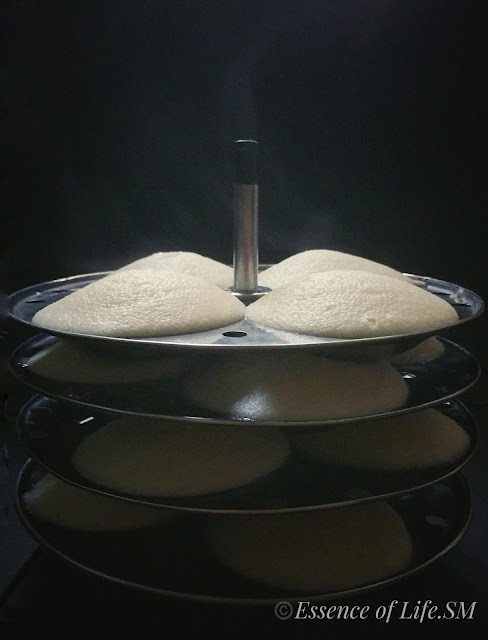
STEAM COOKING THE IDLIS :

  • Pour some Water into the Idli Vessel/Steamer. Cover & Boil the water in Medium-high flame.
  • Grease the Idli moulds.  (Some lay Muslin cloths over the Idli Moulds)
  • Pour a ladle full of Idli batter into each mould. Follow the suit with the rest of the Idli Plate/Moulds.
  • Carefully place the Idli Moulds into the Idli Vessel and cover it tightly with the lid.
  • Steam cook the Idlis for about 4-5 Minutes on a High flame, reduce the flame to medium-low and cook for another 3-5 Minutes. 
  • Do not over cook the Idlis.
  • The right time to remove the Idlis are when the steam emanates the wonderful aroma of steamed Idlis. 
  • Remove the Idli Moulds from the Idli Vessel/steamer and leave it aside for few minutes.
  • Do not remove the Idlis from the Idli moulds immediately, they would be sticky.
  • Once the Idlis are slightly cooled down, gently dip a spoon in cold water and carefully remove the Idlis from the mould.
  • Serve Idlis hot with Sambar or any Chutney of your choice.


STORING THE IDLI BATTER:

  • Once the batter is fermented, it can be stored in the refrigerator for up to 3-4 days.
  • Remember to bring the batter to room temperature before making Idlis.


SERVING SUGGESTIONS :

   
  • Idli is typically served with a variety of Chutneys and Sambar, each with its own unique style and taste.
  • Indulge in the heavenly combination of deep-dunked Idlis in a pool of flavourful Sambar, known as SAMBAR IDLI.
  • For a delightful twist, try PODI IDLI by sprinkling Idli Podi and drizzling Gingelly oil over the Idlis.
  • Another delicious option is IDLI FRY, where the Idlis are cut into small cubes, deep-fried, and optionally served with a sprinkle of Idli Podi.

For more CHUTNEY RECIPES, Click here...

Idli can be also be served along with a combination of Vegetarian/Non vegetarian Curries.

MUTTON CURRIES :

Kongu style Mutton Kuzhambu
Nadan Mutton Curry
Varutharacha Mutton Curry
Thanjavur Mutton Mundhiri Varuval
Mutton Kola Urundai Kuzhambu

CHICKEN CURRIES :

Chicken Kurma
Nattu Kozhi Kuzhambu
Spicy Chicken Curry

FISH CURRIES :

Fish Curry with Raw Mangoes
Chettinaad Fish Curry


VEGETARIAN CURRIES :

Kongu Thakkali Kuzhambu
Tiffin Sambar
Vegetable White Kurma
Tomato Kurma
Vegetable Kurma
Ennai Kathirikkai Kuzhambu
Beetroot Curry
Tomato Curry


Newer Posts Older Posts Home

Search Essence of Life - Food

Popular Posts

  • Pesaha Appam & Paal Recipe | Traditional Kerala Indri Appam for Maundy Thursday
  • How to Make Kerala Kanji | Traditional Rice Porridge with Payar, Chammanthi & Achar
  • Kizhi Parotta: Kothu Parotta and Salna Wrapped in Banana Leaves
  • Maida Chapati - All-Purpose Flour Chapati
  • Madurai Mutton Chukka Varuval

Ebook - "What I Cook – For Onam"

Ebook - "What I Cook – For Onam"
Celebrate Onam the authentic way! Discover 25 timeless Kerala Sadya recipes in my ebook What I Cook – For Onam. From avial to payasam, bring home the flavours of tradition. Available now on Amazon!

I Me Myself

SM - Essence of Life
Essence of Life - Food is all about daily cooking with a simple sense of taste and health. It is all about food. Not a day goes by without eating for most of us, so what we eat matters on the whole.

Food in the mode of goodness increases the duration of life, purifies one's existence, and gives strength, health, happiness, and satisfaction. Above all ingredients, the most vital one in my kitchen is love.
Sm
@ Essence of Life - Food

Subscribe Essence of Life - Food

"Guide to our Cookie Policy"

  • Cookie Policy

ASK FIRST!

Please note that all rights for the photographs and texts on this blog, unless otherwise mentioned, rests with the author. Please do not use without permission.

Labels

AROUND THE WORLD 160 BAKING 23 BEVERAGES 18 BIRIYANI & PULAO 28 BREAKFAST 78 CURRIES 103 DESSERTS 118 FROM GODS OWN COUNTRY 178 From My Family's Kitchen - Heirloom Recipes 52 GLOSSARY 23 HOW TO... 64 KERALA PALAHARAM 20 KONGU CUISINE 21 KUIH MUIH 5 MALAYSIAN CUISINE 80 MIDDLE EASTERN CUISINE 12 Manvasanai - Flavours from Tamil Soil 126 PICKLES 26 RICE DISHES 65 ROTIS 9 SADHYA 117 SNACKS & SAVOURIES 69 SOUPS 10 SPICE POWDERS 18 TIFFIN ITEMS 64 VIRUNDHU 15 WINES 10 eBook 1