Essence of Life - Food
  • Home
  • From My Kitchen
    • Heirloom Recipes
    • From God's Own Country
    • Sadhya
    • Kongu Cuisine
    • Chettinaad Cuisine
    • South East Asian
    • Around the World
  • Ebook
  • I Me Myself
A stack of soft, thin Indian chapatis with golden-brown spots on a wooden chakla board next to a traditional brass container, demonstrating the Liquid-First method

Soft Chapati - My 35 Years of Mastery


The Secret to Soft Chapati: My "Liquid-First" Method (Stays Soft for Long Hours!)


35 Years of Mastery | 10-Year Blog Anniversary Special | The Definitive Masterclass — After 10 years of food blogging and a landmark 900 recipes at Essence of Life - Food, I am sharing the technical refinement of my signature Soft Chapati. Using my unique "Liquid-First" method, I’ll show you how to achieve paper-thin, pillowy results that stay buttery-soft for a full day. Master the nuances of gluten development and heat management for restaurant-quality results at home.


A 10-Year Milestone: SM’s Note

    This post was originally shared on 1st February 2018. As I commemorate 10 years of blogging on 17th January and reach my 900th recipe milestone, I felt it was only fitting to revisit my signature Chapati. I have completely refined this guide to include nuances mastered over 35 years.(Now dont try to guess my age!)

A complete Indian kitchen station for making soft chapatis showing a wooden rolling board (chakla belan), whole wheat dough balls in flour, and a chapati cooking on a hot tawa.
How to Make Soft Chapatis - Step-by-step Guide


The Philosophy of the Staple: A Culinary History

    If any food is taken for granted, Chapati (Roti) and Rice top the list. While Asia is often seen as a rice-centric culture, India possesses a beautifully unbiased palate where wheat and rice coexist as equals.  As wheat and rice are the two major staples throughout India, we find a relatively unbiased society in the true sense of eating.  I used to wonder about its origins—how it travelled through civilisations to suit regional palates. Blogging has taught me that even the most "simple" dish has a complex soul.

"Looking for that paper-thin, restaurant-style Roti at home? Check out Maida Chapati Recipe here... It's a top-rated 'cheat version' that is incredibly simple and perfect for the home cook!"


The Art of the Perfect Dough

    A Chapati is only as good as its dough. Traditionally prepared with finely milled Whole Wheat Flour (Atta), Salt, and Water, the magic lies in the resting period. This allows the gluten (the protein in wheat) to relax, ensuring your flatbread is pliable rather than rubbery.

Why You Will Love This Recipe

  • Stays Soft for long Hours: No more "cardboard" chapatis by dinner time.
  • Unique Technique: My "Liquid-First" method ensures even hydration.
  • Beginner Friendly: Detailed tips on rolling and heat management.
  • Healthy & Pure: No preservatives, just whole-grain goodness.


Recipe Overview

  • Cuisine: Indian
  • Recipe Type: Main Course / Flatbread
  • Yields: 25 Chapatis
  • Servings: 4-5
  • Difficulty: Medium (Beginner-friendly with tips)
  • Author: SM @ Essence of Life - Food

Time Estimate

  • Preparation Time: 10 Minutes
  • Resting Time: 30 Minutes to 1 Hour
  • Cooking Time: 20-30 Minutes
  • Total Time: ~1 Hour


A Glossary of Grains: Choosing the Right Atta

The grain you choose is as important as the technique. For the softest results, look for these varieties:

  • Sharbati (The "King" of Wheat): High in natural oils and maltose. Yields naturally sweet chapatis that stay soft longest.
  • Lokwan: A premium amber grain known for a rich, nutty aroma.
  • Khapli (Emmer Wheat): A heritage grain, low in gluten and Glycemic Index.
  • MP Durum (Kathia): Provides incredible strength for rolling paper-thin discs.


The Toolkit & Technique Guide (Pro Tips)

  • The Gear: Use a steady rolling board (Chakla / Chapati Palagai / Palaka) and a wooden rolling pin (Belan / Chapati Kattai).
  • The Geometry: Focus on even thickness. If the edges are thick and the center is thin, the chapati will turn hard. Use light pressure.
  • The "Pulka" Trick: For a dramatic puff, cook partly on the griddle and flip directly onto a high open flame.
  • Dusting Tip: Use Rice Flour for dusting. Unlike wheat flour, it doesn't get absorbed into the dough; it creates a fine barrier for a silk-smooth finish without sticking.


How to Make Soft Chapati: Step-by-Step Guide

Soft Chaptis stacked on a wooden board with dough and flour nearby showcasing the cooking scenario

Soft and Thin Chapatis that lasts soft for long hours


Ingredients 

The Liquid Base:

  • 250g Water @Room temperature
  • 20–25g Sugar 
  • 25g Oil (Added to the water)
  • 5g Extra Oil (For the final drizzle over the dough)
  • Salt to taste

The Flour:

  • 325g Whole Wheat Flour (Atta), sieved
  • Wheat Flour or Rice Flour (For dusting)


Method - Detailed Cooking Instructions


Step 1: The "Liquid-First" Technique

  • In a large bowl, combine the water, salt, sugar, and the 25g of oil. Mix until the salt and sugar are completely dissolved.

Pro-Tip: Adding flour to the liquid ensures every protein molecule is hydrated instantly and evenly.

Step 2: The Swirl & Knead

  • Add the 325g of flour to the liquid. Swirl your fingers through it until the flour has fully absorbed the liquid. Once it forms a rough mass, knead for 5–6 minutes until the dough is smooth, pliable, and elastic.

Step 3: The Final Drizzle & Proving

  • Drizzle the remaining 5g of oil over the dough, give it one final light knead, and set it aside.

Step 3: The Resting Phase 

  • Wrap the dough in a wet kitchen towel or cover tightly. Let it rest for atleast 8-10 minutes. 

Note: Rest for at least 8–10 minutes (up to 1 hour). As my neighbour Mami said, you must let it "prove" to relax the gluten, making the dough softer and easier to roll. 

Step 4: Rolling  

Step-by-step chapati making process showing dough being rolled with a wooden belan, a roti cooking on a tava griddle, and finished soft chapatis stored in a traditional brass casserole.

Step-by-Step Visual Guide: Rolling and Cooking the Perfect Soft Roti


  • Divide the dough into equal balls. 
  • Before cooking, give the dough a quick knead. 
  • Roll it into a log and pinch out equal portions. 
  • Roll these into smooth balls and dust lightly with wheat/rice flour.
  • Using your Chakla and Belan, roll into thin circles. 
  • Aim for even thickness; thick/uneven edges will result in hard Chapatis. 
 

 *The Dusting: I first read about using Rice Flour for dusting in a ₹25 cookbook I bought way back in my school days (1989)! It doesn’t stick to the dough, making it easy to dust off before cooking. But practicability has taken me to the classic road of using wheat flour for dusting. Choice is yours.


Step 5: The Heat 

A soft whole wheat phulka roti puffing up with steam over an open high flame on a metal grill, using the traditional Indian fire-searing method for airy layers.

The "Phulka" Trick: How to Achieve 100% Puffy Phulkas Every Time


  • Heat your Tava (griddle) on a high flame.
  • For Beginners: If you find rolling while cooking tough, roll 4-5 chapatis first. Keep them on a plate covered with a damp kitchen towel, so the air doesn't dry them out into a "crust."
A fully puffed-up whole wheat phulka roti ballooning over an open blue gas flame on a metal grill, demonstrating successful internal steam separation and paper-thin layers.

Master Perfectly Puffy Phulka 

  • My Style: I roll and cook simultaneously in a 60-second cycle for each chapati!
 
  • The High-Heat Sear Heat your Tava (griddle) on a high flame. Place the rolled chapati. When tiny bubbles appear, flip. Cook until golden-brown spots appear.
  • Heat Management: Lower the flame between two chapatis. This stabilises the heat of the tava so the next one doesn't scorch instantly. But always make sure to cook the chapatis in high flame in quick movements.
  • For Pulka: For a dramatic puff, cook one side of the chapati over the griddle and then quickly move the partially cooked chapati directly onto an open high flame. The steam will force the layers apart instantly! 


    A whole wheat Pulka roti puffing up dramatically into a balloon shape over a blue gas flame on a metal grill, showcasing internal steam expansion.

    Soft Phulka/Chapati - Mastering the Heat for Puffy Phulkas


    Note: While planning for Phulkas, reduce the oil, while kneading and also knead the dough for about 8-10 minutes


Step 6: Stacking & Humidity Hack

  • Transfer chapatis to a casserole lined with a clean kitchen towel. 
  • Once the batch is done, cover the stack with the towel and reverse the whole stack (bottom to top). 
  • This redistributes heat and keeps them from getting soggy due to condensation.

 
A stack of perfectly cooked soft chapatis with golden-brown spots served on a wooden board next to a traditional ornate brass casserole.

Soft and thin perfectly cooked Chapatis


Pro Tips and Notes: The Masterclass Secrets

  • The Gram-Perfect Rule: While cups are convenient, measuring in grams is the secret to consistency. Flour density changes with humidity and brand; weight never lies. Use the 250g water to 325g flour as your gold-standard starting point, but always be prepared to "listen" to the dough and adjust by a few grams as needed.
  • The Humidity & Weather Factor: Wheat flour is incredibly sensitive to the environment. On a humid or rainy day, the flour naturally absorbs moisture from the air, making your dough stickier than usual. Conversely, in dry or air-conditioned kitchens, the flour can become "thirsty" and parched.
    • If the dough is too sticky: Sprinkle in an extra tablespoon of flour at a time. Do not overdo it, or the Chapati will become heavy.
    • If the dough feels dry or tight: Do not pour water! Instead, dip your fingers or fist into a bowl of water and continue kneading. This "wet-hand" technique allows for precise moisture control without making the dough sloppy.
  • Sourcing the Right Atta: For the longest-lasting softness, look for 100% Sharbati Wheat. Its higher natural sugar and oil content make the dough "thirstier," allowing it to hold onto moisture far better than standard durum wheat.
  • Sieve the flour: Always sieve your flour before measuring and kneading. This aerates the Atta, ensuring there are no hidden lumps and that the "Liquid-First" hydration happens instantly and evenly.
  • The Chapati Press: If using a chapatipress, use a touch of oil on the plates to prevent sticking.
  • To Drizzle or Not to Drizzle Ghee/Oil: Many kitchens drizzle oil while the Chapati is on the heat, but I find this creates excess smoke that can alter the nutty flavour of the wheat. I personally avoid this as my family prefers them non-greasy.
    • My Alternative: For a touch of luxury, skip the oil on the pan and instead smear a little ghee or butter over the Chapatis after they come off the heat. It provides the indulgence without the smoke.
  • Managing Greasy Stacks: If you do choose to use oil while cooking, remember that fat holds heat longer. To prevent the bottom Chapatis from getting "crushed" and oily, reverse the stack (move the bottom one to the top) every 5 or 6 additions to let them breathe.
  • Tool Maintenance: Ensure your Chakla (Rolling Board) is steady. If it wobbles, place a damp kitchen cloth underneath it. A steady board is the secret to achieving that even, "same-throughout" thickness. 

 
A hand lifting a steaming, fully puffed whole wheat chapati from a wooden rolling board, showing the airy internal pocket and extremely thin, soft texture.

Perfeclty cooked soft Chapatis - Liquid First Method


Serving Suggestion - Evolution of the Side Dish: From Potato to Paneer

  • Growing up, the classic combination at home was Potato Masala. 

  • Then came Vegetable Kuruma 

  • And Sundays were dedicated to Chicken or Mutton Curries. 
  • Thanks to the late 80s intervention of Doordarshan, North Indian staples like, Dal Makhani, Butter Chicken, and Paneer Mattar are now South Indian staples too. 
  • Talk about Subjis &  Da Tadkas, it feels like we've cooked them forever!


nostalgic Ambuli Mama style illustration of an old Indian traveller eating chapatis under a Banyan tree, representing the traditional "fast food" of the ancient world. 

“My memory of Chapatis as the ultimate travel food isn’t just from the anecdotes I have listened to train journeys taken by kith & kin and their boxes of chaptis; it’s rooted in the stories I grew up with. In the pages of Chanda Mama (Ambuli Mama) and Panchatantra, travellers whether they were merchants on bullock carts or seekers on foot, always carried a humble cloth bundle. Inside, there were always Chapatis. They were the original 'fast food' of the ancient world, sturdy, reliable, and perfectly paired with just a raw onion or a bit of spicy pickle. It’s a tradition of portability that we still carry with us today.”


Storage Suggestions 

Freshly Cooked Chapati - Ready to Serve 

  • Storage: Store in an insulated casserole lined with a fresh cloth towel to absorb excess moisture.

Storing Half-Cooked vs. Fully Cooked Chapatis

    Whether you are a busy professional or just like to stay ahead of the week, mastering the art of the "Half-Cooked" (Par-baked) Chapati is a game-changer. This method preserves the dough’s elasticity better than freezing fully cooked ones.

The Half-Cooked Method (Best for "Fresh" Results)

  • The Technique: Place your rolled chapati on a hot tava. Cook for only 10–15 seconds per side. You are looking for the dough to change colour from translucent to opaque, with zero brown spots. It should still be limp and pale.
  • Cool it before Storing: This is critical. Lay them out individually on a wire rack or a clean cloth until completely cool. If you stack them while warm, they will stick together and become a single mass of dough. 
  •  Refrigeration (Up to 1 Week): Stack the cooled, pale chapatis with parchment paper (baking paper) between every 2–3 layers. Place in a zip-lock bag, pressing out all the air.
  • Freezing (Up to 3 Months): Place parchment paper between every single chapati. Store in a heavy-duty freezer bag.
  • To Serve: Take the pale chapati directly from the fridge/freezer and place it on a smoking hot tava. It will puff up and develop those beautiful golden spots just like a freshly rolled one.
Close-up of a fully puffed soft chapati on a wire rack, highlighting the smooth, thin texture and light golden spots achieved through proper kneading.

Soft Puffed-up Phulka/Chapati

If you have already finished your cooking session and find you have leftovers:

  • Refrigeration: Once cool, store in an airtight container. Use within 3–4 days.
  • Freezing: Follow the parchment paper stacking method.
     

Pro-Tip: Fully cooked chapatis lose a bit of moisture in the freezer. When reheating, always use the "Steaming Method" (the microwave steaming bowl or a damp towel) to restore that pillowy softness.


Why Air is the Enemy

Whether half-cooked or fully cooked, the secret to longevity is Oxygen Control.


Note: Use freezer-safe bags and squeeze out every bit of air before sealing. Air causes "freezer burn," which dries out the edges of the chapati, making them crack when you try to reheat them.

 Reheating Mastery: The Steaming Method

If you own a microwave steaming bowl (the one with the water reservoir and vented lid)

  • Add water to the reservoir.
  • Place your chapatis on the tray.
  • Steam for 45–60 seconds.

Note: Don't have Steamer? Place a small cup of water in the corner of the microwave. The water absorbs the excess microwave energy and creates a humid environment, preventing your bread from turning into a cracker! 

FAQs

Q: Why are my chapatis hard? 

  • Usually due to low heat or insufficient kneading/resting. High heat is essential to create internal steam.  

Q: Can I use a Roti maker? 

  • Yes, for convenience, but hand-rolled chapatis generally have a superior, airier texture.  

Q: Why do I need to cover the dough? 

  • To prevent a dry "crust" from forming, which creates hard lumps during rolling.


Cultural & Linguistic Glossary

  • Atta: Whole wheat flour.
  • Chakla / Chapati Palaka(palakai): The circular rolling board.
  • Belan / Chapati Kattai: The rolling pin.
  • Pulkas: Chapatis puffed over an open flame.


A 35-Year Badge of Confidence: From My Kitchen to Yours

    I began my journey with the rolling pin at the age of fifteen. From that very first attempt, I was struck by a stroke of beginner’s luck—my chapatis turned out perfectly round and remarkably soft. To this day, I can’t quite explain how that initial magic happened, but it was a gift that stayed with me.

    Since those early days, the "soft and round" comment has been the steady soundtrack of my life in the kitchen. From my Mom and Dad to our relatives; from my college mates who shared my tiffin to my husband’s family, friends, and acquaintances, whoever has tasted them has left with the same remark: “They are so thin and so soft.”

From family to friends, from college tiffins to in-law kitchens, the comment never changed:

“So thin… so soft.”

Close-up of a fully puffed, soft whole wheat chapati on a grill or in a griddle, highlighting the smooth texture and even hydration of the dough.

The Signature Result - Soft and Thin Chapatis


This recipe is that journey—every mistake, every correction, every lesson passed down by experience.

    Over time, those compliments became my "Badge of Confidence." What started as luck transformed into a craft. 35 years of kitchen trials have led to this moment: a Chapati so soft that it defies time, staying fresh and pliable for long hours. This recipe is a tribute to my decades of trial and error, the tiny bits of wisdom gathered through experience, and that first spark of guidance from my neighbor, Mami.

Give this "Liquid-First" method a go and tell me, if you were able to make softest Chapatis. 

CHAAT ITEMS - INDIAN STREET FOOD
BOONDI
      

    Boondi is a light snack prepared with Chickpea(Bengal Gram Dhal) Flour & seasonings. If you can perfect the consistency of the batter, then making Boondi is a simple task. Snack it up as such or with a sprinkle of Chaat Masala. Crispy Boondis taste great with a cup of Tea/Coffee. Boondis can also be used to make Boondi Raitha or is one item added into Pani Puri, Bhel Puri, Dahi Papdi etc.,


    Though making Boondis require a bit of practice if you can get the right consistency with the batter, then the job gets much easier & Boondis turn out to be crisp and round. Traditionally a slotted ladle called Boondi Jhara is used for pouring out the batter through which these tiny roundels fall. These Boondhi Jharas have wide slots at the top & it narrows at the bottom, which facilitates a perfect flow of the batter yielding perfectly rounded Boondis. But you can get the job done with a simple slotted spoon too. But the shapes may not be as round and perfect as it comes out when you use a Boondi Jhara. I do not have a Boondi Jhara & I usually make these Boondis with a slotted spoon.


    I make Namkeens like Sev, Aloo Bhujia, Boondi, PapChaat itemsdi, Namak Pare etc., while making Chaat items like Pani Puri & Bhel Puri at home. I make these Namkeens to mix along with the Chaat Items and a few batches for extra snacking. Boondi is a simple savoury snack prepared with just Chickpea(Bengal Gram Dhal) Flour. A quick fix and a light snack. Season it up with Chaat Masala for an extra note of flavour.


    Another snack of the same genre is Kara Boondi which is Boondis South Indian counterpart which is slightly spicy. Kara Boondi is a combination of Chickpea Flour & Rice Flour with spices & seasonings, fried Curry Leaves and Cashews for an extra richness of flavour and taste. Kara Boondhi is also one snack added to South Indian Mixture Recipe along with various other tiny little savouries.  


Points to remember before making Boondi Namkeen:


  • The consistency of the batter plays a significant role in the shape & texture of Boondi.
  • Make sure the flour has no lumps.
  • Blend the Gram Flour, Turmeric, Salt & Soda-bi-carbonate along with 1/2 a Cup of water.
  • Then pour in the remaining 1/4 Cup of water and blend it without any lumps.
  • Blending it yields you with a perfect batter, with no lumps.
  • 1 Cup of Gram Flour needs 3/4 of Water for the right consistency.
  • This measurement is perfect and yields out perfectly shaped Boondis.
  • Soda-bi-carbonate also helps to yield perfect round shaped Boondis. But adding it is purely optional.
  • Boondi Jhara makes the task easier when it comes to the shape of a Boondi.
  • I use a simple slotted spoon for the purpose.  
  • If the consistency of the batter is perfect, then slotted ladles also do justice in getting perfectly shaped Boondis.
  • Fry boondis on a medium flame until Boondis are well cooked and turn crisp.
  • Make sure that Boondis do not turn brown. It should be yellowish.


For more CHAAT ITEMS, Click here...


 Cuisine - North Indian

 Recipe Type - Snacks, Namkeen

 Spice Level - Low

 Difficulty - Medium

 Yields - Approx 2-3Cups

 Author - SM


Preparation Time - 10-15 Minutes

Cooking Time - 20 -30 Minutes


For more SNACKS & SAVOURIES, Click here...


HOW TO MAKE BOONDI - NAMKEEN BOONDI


INGREDIENTS:


Bengal Gram Dhal Flour (Besan) - 1 Cup

Turmeric Powder - a Pinch 

Salt - To Taste 

Soda-bi-carbonate - 1/2 a pinch(Optional) 

Water - 3/4 Cup

Oil - To Deep Fry. 


METHOD:


  • Make sure the flour has no lumps.
  • Blend the Gram Flour, Turmeric, Salt & Soda-bi-carbonate along with 1/2 a Cup of Water. 
  • Then pour in the remaining 1/4 Cup of water and blend it without any lumps.
  • Blending it yields you with a perfect batter, with no lumps. 
  • Heat oil in a pan, reduce to a medium flame while frying the boondis.
  • You will need TWO slotted ladles for the purpose.
  • One slotted ladle is to pour the batter through for making Boondi and the other one for draining it.
  • Hold one slotted spoon just above the hot oil, pour a ladle full of batter over the slotted spoon and spread it.
  • Ensure that the batter flows evenly through the slotted spoon and falls into perfect balls.
  • The flour & the water consistency I have given is perfect enough to get perfectly shaped Boondis.
  •  *1 Cup of Gram Flour needs 3/4 of Water

  • Fry the boondis on a low flame, turning them continuously.
  • This would ensure even cooking.
  • When the sizzling sound stops, drain the Boondis with the other slotted spoon.
  • Spread them over Paper towels.
  • Repeat the process for the remaining batter.
  • Sprinkle some Chaat Masala for an extra note of flavour.
  • Boondi serves best as a Tea Time Snack.
  • Can also be added into Chaat Items like Pani Puri, Bhel Puri, Dahi Puri etc.,
  • Boondi can be used to make Boondi Raitha.


NOTES:


  • Adding Soda-bi-carbonate is optional. It will add crispiness & also helps to yield perfectly shaped Boondis.
  • Deep fry the boondis on a very low flame. Otherwise, the boondis may turn brown.
  • Drop the batter into hot oil through the slotted spoon and fry the boondis until the sizzling stops.
  • Make sure that Boondis do not turn brown. It should be yellowish.


FRIED RICE
SAMBAL FRIED RICE
    Sambal Fried Rice is a Spicy Fried Rice with Shrimps/Prawns, Eggs, Carrots, Greens and fresh homemade Sambal.The best about a Fried Rice is that it is quite adaptable, versatile and can cater to satisfy your whims and fancies. This spicy Sambal Fried Rice is not the HOT type, but the spicy type which can treat your spice reckoned taste buds to utmost satisfaction.  Freshly prepared Sambal has a fragrance that makes this Fried Rice inviting and beckons you to eat more.
     Sambal is a hot & spicy condiment mainly prepared with Red Chillies, Spices, Herbs and Aromatics.  Though Fried Rice/Nasi Goreng has nothing to do with being Spicy, it has adapted along with the Cuisine unique to Malaysia, Indonesia and Singapore.  It is a literal adaptation associated with Culture more than Cuisine where Sambal is one base condiment, sauce or relish which can be incorporated into almost every dish.
     I have prepared fresh Sambal for this Sambal Fried Rice, by soaking Dry Red Chillies and grinding it along with Shallots, Garlic, Galangal and Belacan.  If you are from a region where these fresh ingredients aren't available, you can go for store-bought Sambal Paste from Asian Groceries.

For more FRIED RICE RECIPES, Click here...

 Cuisine - Malaysian, Indonesian (South East Asian)
Course - Main
Spice Level - Medium - High
Difficulty - Easy
Serves - 4
Author - SM


Preparation Time - 15 - 20 Minutes
Cooking Time - 25 -30 Minutes

HOW TO MAKE SAMBAL FRIED RICE

INGREDIENTS :

For Sambal Paste :

Dry Red Chillies -  5 Pieces.
Birds-eye Chillies - 3 Pieces
Shallots - 5 Nos.
Garlic - 2 Cloves.
Dry Shrimp Paste(Belacan) - 1 Tspn
Galangal - a Small Piece
Tamarind - 1 Tspn
Salt - To Taste
Palm Sugar (Gula Melaka) - 1 Tspn

For Fried Rice :

Jasmine Rice : 2 Cups (Cooked)
Onions - 1 No.
Garlic - 2 Cloves
Bird's Eye Chillies - 1-2 Nos.
Shrimps/Prawns - Few
Carrot - 2 Tbspn
Cabbage - few Shreds
Light Soy Sauce - 1 Tbspn 
Sambal - 3-4 Tbpsns
Lemon Grass - 1 Stalk
Salt - To Taste
Sugar - 1 Tspn 
Rice Wine Vinegar - 1 Tspn
Oil - 2-3 Tbspn
  

To Garnish :

Spring Onions/Chives - Few Stalks

METHOD :

For Sambal :

  • Soak the Dried Red Chillies in hot water for 20-30 minutes until they are soft.
  • Dry roast the Shrimp paste until fragrant.
  • Grind all the ingredients mentioned under 'For Sambal Paste' into a smooth paste and keep it aside.
  • Heat oil in a pan and saute the ground paste on a high flame for about 10 minutes or until all moisture evaporates.
  • If the mix is a bit dry, add some more oil and saute them on a low flame for another 5-10 minutes or until oil separate from the mix.
  • Add tamarind extract and boil it for another 5 minutes on a low flame.
  • Add salt and palm sugar and mix well.
  • At this stage, the sambal should be fragrant, if not saute it for some more time.

For more Recipes with SAMBAL, Click here...

FOR SAMBAL FRIED RICE : 

For a detailed recipe of how to cook Jasmine / Fragrant Rice, click here...

  • Cook the fragrant rice as per instruction and allow it cool.
  • Heat 2 Tspn of Oil in a large pan, fry or scramble the Eggs. 
  • Remove it from the pan and keep it aside.
  • Cut Lemon Grass Stalk into small pieces, use just the white part of it.
  • Can Grind the Lemon Grass along with the Sambal ingredients, or just bruise them and add it while sauteing.
  • Peel, devein and wash the Prawns/Shrimps.  Keep them aside.
  • Heat Oil in a pan/wok, Saute finely chopped Onions, Garlic and Bird's eye chillies until onions turn translucent.
  • Add Sambal Paste and fry this on a high flame for 2-3 minutes.
  • Pour in Light Soy Sauce and give a quick stir.
  • Add Prawns/Shrimps, finely diced Carrots along with a dash of Salt and a pinch of Sugar.
  • Allow it to cook on a high flame for few minutes. 
  • Add cooked Fragrant Rice.
  • Drizzle Rice Wine Vinegar over the rice.
  • Mix it well until every grain is well coated with the Sauces and Sambal.
  • Stir in finely shredded Cabbage and Scrambled Eggs to the rice. 
  • Fry the rice on a high flame for few minutes or until the rice is dry. 
  • Switch off the flame. 
  • Garnish Sambal Fried Rice with finely chopped Spring Onions/Chives.
  • Serve Sambal Fried Rice hot with any dips, sauces or side dishes of your choice.

NOTES :

  • I used the long- wrinkled variety which is less spicy. To reduce the spiciness can snip off the soaked dry chillies into two and de-seed them.
  • Adjust the number of Chillies to suit your spice level.
  • Blend the shallots coarsely.
  • Grind the paste with less water to avoid splattering while sauteing the Sambal in high flame.
  • Can add Sugar instead of Palm sugar.
  • Any fragrant long-grained rice variety can be used for the recipe.
  • Use a day old cooked rice for best results. Obviously, keep them refrigerated.
  • Can add any vegetable of your choice in this Fried Rice.
  • Can also Chicken Pieces, Fish or any other Seafood. 
  • Can fry the Eggs and use them as a side dish or scramble them up and mix along with the fried rice. 

   
CURRIES - VEGGIES
VEGETABLE WHITE KURMA

     What is the secret of a great Kurma? Cooking the best Kurma can be more inviting and can even waft its aroma out of your kitchen into the streets, that neighbours should be able to say "something nice is cooking up in the neighbourhood".  I don't know about my neighbours, but my husband would always say the moment I open the gate when he comes back from his Office "Vasana Thookkala Irukku"(Smells Great), what did you cook? But as my Dad says "Manam Irukku Gunam Irukka?" (Smells Great, is it good enough).  All comprised together good cooking totally comes from perfecting the recipe. A cook should know what to add and when to add and how long it should be sauteed, boiled, cooked etc., with a confidence to improvise and to extract the maximum flavour from the ingredients.
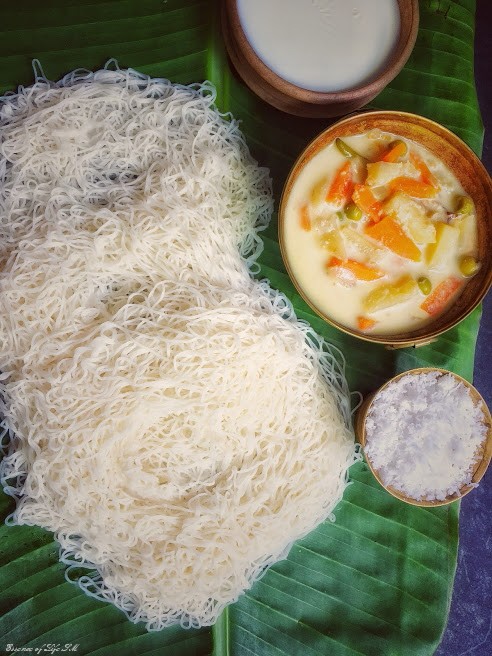
     This Vegetable White Kurma/Vellai Kurma fits perfectly into all criteria - rich, aromatic and does total justice to any dish it is served along with Idiyappam, Appam, Chapathi, Parotta or Pulaos. Tastes great with Idli, Soft White Dosas, Uthappams too. The best about this Vegetable White Kurma is that the smell of the Curry lingers in your palms even after hours.  This recipe is from an old recipe book my Dad gave me and there is the last note below the recipe saying "Warning: Do not prepare this Kurma for your guests, they may stay back at your place forever".
      Vellai Kurma/White Kurma as it is commonly called is a simple recipe, but a rich and flavourful Curry.  Yogurt/Curd and Fresh Cream gives a rich texture and colour to this White Kurma. I personally love this Kurma and it is a great combination for Idiyappam. If any side dish that can beat Idiyappam & Aatukkal Paya/Mutton Paya combo, then it should be this Vegetable White Kurma.


Cuisine : South Indian
Recipe Type : Curry, Gravy
Course : Side Dish
Spice Level  : Low - Medium
Difficulty : Medium
Serves : 3- 4
Author : SM

Preparation Time - 20-30 Minutes
Cooking Time - 30-45 Minutes

INGREDIENTS :

Vegetables :

Carrots -1 No.(Medium Sized)
French Beans - 10-12 Nos.
Cauliflower - 1/2 Cup
Green Peas - 1/2 Cup
Potato - 2 Nos.(Small Sized)

Spices :

Fennel Seeds - 1 Tspn
Bay Leaf - 1 No.
Cloves - 3-5 Nos.
Cinnamon (1" Stick) - 2 Nos.
Cardamom - 3 Pods

To Saute :

Onion - 1 No.
Curry Leaves - 2 Sprigs
Green Chillies 5-6 Nos.
Ginger Garlic Paste - 2 Tbspn
Tomato - 1 No.
Coriander Powder - 2 Tspn
Yogurt/Curd - 1 Cup
Fresh Cream - 1/2 Cup
Salt - To Taste
Oil /Ghee - 2 Tbspn


For Coconut Paste :

Coconut -1/2 Cup
Cashew nuts - 10 -12 Nos.
Poppy Seeds(Khus Khus) - 2 Tbspns

To Garnish : 

Coriander Leaves - Few

METHOD :

  • Clean, wash and cut Carrots, Beans and Potatoes lengthwise (1" long pieces).
  • Clean, Wash and Cut Cauliflowers into florets.
  • Peel the Green Peas, wash and keep them aside.
  • Soak Poppy Seeds in 1 Tbspn of water for about 10-15 minutes and grind it along with grated Coconut and Cashew nuts to a fine paste.
  • Heat Ghee/Oil in a Pan, splutter the ingredients mentioned under "Spices' on a very low flame until fragrant.
  • Immediately add finely chopped Onions, Green Chillies (slit into two) and Curry leaves on low flame until Onions turn translucent.
  • Add Ginger-Garlic Paste and saute until raw flavour goes.
  • Add finely chopped Tomatoes and saute until i is well cooked.
  • Sprinkle Coriander Powder and fry for a while on a very low flame until fragrant and oil separates from the mix.
  • Pour  Curd/Yogurt and mix well.
  • Add the Vegetables to the above Masala along with Salt and a pinch of Sugar.
  • Add enough water, cover and cook until vegetables are well-cooked.
  • Open the lid and give the mix a quick stir.
  • Pour in the ground Coconut Paste and mix well.
  • Allow it to boil on a very low flame until raw flavour goes, stirring occasionally.
  • Finally, pour in the fresh cream and give a quick stir.
  • Remove from fire and garnish it with Coriander Leaves.
  • Serve hot with any dish of your choice.
  • Goes well with Roti, Chapati, Parotta, Idli, Dosa, Uthappam, Idiyappam &Appam.
  • It is a good accompaniment for rice varieties like, Ghee Rice, Peas Pulao, Jeera Rice etc.,

NOTES :

  • Can use any classic vegetables for this Curry.  
  • Can use Turnips, Beets, Paneer etc., along with vegetables mentioned above.
  • Can pre-cook the vegetables and then add it to the masala too.
  • Cooking the vegetables in masala gives more flavour filled Curry.
  • Adding Yogurt & Fresh Cream are totally optional, but it gives a good texture & richness to the curry.
  • Adjust the number of green chillies to suit your spice level.
  • Soaking the Poppy seeds prior to grinding yields a thick coconut paste.
  • Do not over boil or cook in high flame, once coconut paste is added to the Curry. This can curdle the Curry and make it watery.
  • Adding a pinch of Sugar while cooking the vegetables is to retain the colour of the vegetables.
  • For richly flavoured Kurma, saute the ingredients in Ghee.

HOW TO MAKE IDIYAPPAM FLOUR

TIFFIM ITEMS
IDIYAPPAM
     Once you have the Idiyappam Flour, making Idiyappam becomes an easily executable task and it can be prepared within minutes. Fresh homemade Idiyappam flour yields soft Idiyappams.  The quality of the rice plays a major role in soft textured Idiyappam. Raw Rice suits well for making Idiyappam flour.  Preparing Rice flours for Puttu/Idiyappam/Appam is a common task in a South Indian kitchen.  Though preparation of each flour is slightly different, the basic ingredient i.e the Rice remains the same.  Usually, a large batch of Rice flour is prepared and stored for later usage. Well prepared and perfectly stored homemade Idiyappam flour stays good for up to 3 months.


Cuisine : South Indian, South East Asian
Course : Main Course
Author : SM

For more recipes from GODS OWN COUNTRY - KERALA  click here...

FOR IDIYAPPAM FLOUR :

Soaking Time : 2 Hours
Drying Time : 15 -20 Minutes
Grinding Time : 10-15 Minutes
Sieving & Preparation Time : 5 – 10 Minutes

INGREDIENTS :

Raw Rice - 2 Cups
Water - To Soak.

METHOD:

For Idiyappam Flour:

  • Clean for any impurities or stones and wash the rice for about 3-4 times or until water runs clear.
  • Soak the rice in water for about 30-45 minutes.
  • Once soaked, drain the water and leave the rice in a colander for 5 Minutes.
  • Dry the Rice in a clean kitchen towel for about 15-20 minutes.
  • Transfer the rice to a mixer grinder, and grind it for few minutes until it is ground into a fine flour.
  • Once the flour is ready, sieve it until no more flour flow out of the sieve.
  • Spread this out on a big platter.
  • Collect the residues left out in the sieve separately and grind it again into a fine powder.
  • Follow the suit until the whole batch of rice is powdered into a finely textured flour.
  • Heat a deep pan on a medium flame.
  • Add the rice flour and dry roast the Idiyappam flour for about 8-10 minutes on a very low flame until the flour is hot and fragrant.
  • Care should be taken not to burn the flour and avoid lumps in the flour.
  • If, there are lumps break them up with the spatula while roasting the flour.
  • Spread this out on a big platter and allow it to cool.
  • Store this in an airtight container for a longer shelf life.
  • Can store this flour in the freezer for up to three months.

NOTES :

  • Idiyappam flour should be finely ground, use a very fine sieve to sieve the flour while preparing the flour for Idiyappams.
  • A good quality Raw Rice suits well for making Idiyappam flour.
  • Quality of the Raw Rice plays a vital role in giving a soft and white Idiyappams.
  • Some recipes even use an equal amount of Raw Rice and Par-boiled Rice in preparing Idiyappam Flour.
  • Dry Roast the ground Idiyappam Flour on a low flame until fragrant and until it turns into a fine texture.(It should feel very light when you touch the rice flour).
  • There should be no lumps in the flour
  • Care should be taken not to burn the Flour while dry roasting.

HOW TO MAKE IDIYAPPAM


TIFFIN ITEMS
IDIYAPPAM

    Once you have the Idiyappam Flour, the job gets much easier.  Can use Store-bought /home-made Idiyappam flour for the purpose.  The most important factor while preparing Idiyappam is to use boiling water to knead the dough.

For more recipes on TIFFIN ITEMS, Click here...

Preparation Time : 10-15 Minutes
Cooking Time : 20-30 Minutes
Difficulty : Medium
Serves : 2-3


INGREDIENTS :

Idiyappam Flour - 2 Cup
Water - 21/2 - 3 Cups(Approximately)
Salt - To Taste
Coconut Oil - 3-4 Tspn(Optional)

METHOD :

  • Boil the Water along with a dash of Salt. 
  • Gradually add boiling water little at a time to the Idiyappam Flour and knead it into a soft dough.
  • Can add some Oil while kneading the dough.
  • Grease the Idiyappam maker with some oil.
  • Fill the Idiyappam Maker with some dough and close it.
  • Press the Idiyappam Maker in a circular motion on a greased Idli Plate/Steamer Plate.
  • Can adjust the size of the Idiyappams to your preference.
  • Meanwhile Pour some water in an Idli Maker/Steamer, cover and allow it to boil for about 5-8 minutes.
  • Carefully open the Idli Maker/Steamer and place the Idli Plate/Steamer plate lined up with Idiyappams into the Idli Maker/Steamer. 
  • Cover the Idli Maker/Steamer and steam cook the Idiyappams for about 2-3 Minutes on a high flame.
  • Lower the flame and steam cook the Idiyappams for another 5-7 Minutes.
  • Once done, remove the Idli Plate/Steamer Plate from the Idli Maker/Steamer and allow it to cool for about 5 minutes before transferring them to a serving plate.
  • Serve Idiyappam hot along with sweetened Coconut Milk, Sugar/Palm Sugar & freshly grated Coconuts.
  • Idiyappam can be served with mild curries like Stews, Aattukkal Paya, Kiri Hodi, Sothi, Vegetable Kurma, Egg Curry with Coconut milk etc.,
  • Goes well with any Vegetarian or Non-Vegetarian Curries too. 
   

IDIYAPPAM & CURRIES 

TIFFIN ITEMS
IDIYAPPAM & CURRIES


NOTES:

  • Perfectly ground and roasted Idiyappam flour yield soft Idiyappams.
  • Adding Boiling water to knead the dough is a must.
  • The kneaded dough should be soft without any cracks.  
  • Adding Oil while kneading the dough is totally optional.
  • Alternatively, shred the Idiyappam and make Lemon Sevai, Coconut Sevai, Tamarind Sevai etc.,
  • Can also try your hand at making String Hopper Biriyani/Pulao. 

TIFFIN ITEMS
IDIYAPPAM

     Idiyappam is another staple dish in South India and around the regions of South East Asian Countries.  Cuisines in these regions use Rice as the main ingredient in the preparation of most of their dishes.  And another main ingredient being Coconuts.  As Rice and Coconuts are two native crops found in abundance, these ingredients are combined together or prepared hand in hand right from a Main Course Dish, Appetizer/Snack, Side Dish or Dessert.  The importance and availability of the above ingredients have made it as a star ingredient not only through the length and breadth of the region but also have spread its wide hands throughout South East Asia.
     Three major Breakfast/Dinner dishes unique to South India and spread throughout South East Asia comprises  PUTTU, IDIYAPPAM & APPAM.  These dishes have a flamboyant past with a long story written throughout the history of Food. Even these dishes have a literary mention since Sanga Kalam in Tamil Poetries.  Their existence dates back since 300BC to 300 AD.  Puttu & Idiyappam are steam cooked which is considered as a healthy way of cooking and Appam is cooked in a clay or iron pan called 'Appa Chatti'.
           
               Idiyappam/Nool Puttu/Noo Puttu/Sevai/Santhagai is a common Breakfast/Dinner item traditionally steam cooked and looks a lot like Rice Noodles.  There are two different schools in the preparation of Idiyappam.  The traditional method is - soaking and grinding the raw rice into a smooth batter along with salt.  Then the ground batter is cooked with few teaspoons of oil in a pan - this is to remove the water content from the batter. Some methods even call for steam cooking the batter in Idli pans as for making Idlis.  Once the batter is cooked they are allowed to cool down and then a wooden or metal Idiyappam Press, with tiny holes at the bottom is used to squeeze out the Idiyappams.  Small handy Idiyappam Press or big ones with stands called Santhangai Press are used for the purpose. Idiyappam prepared with Steam cooked batter can be served as such.  Alternatively, if the batter is not steam cooked press the Idiyappam and then steam cook the Idiyappam in a steamer for 8-10 Minutes.
     Over the years the method of preparing has slightly changed. But the basic ingredient remained the same i.e the Rice. Finely milled rice flour is used for preparing Idiyappams these days instead of grinding the soaked rice.  Preparing Idiyappams with ready-made Rice Flour is considered to be easier than the conventional method of soaking, grinding, cooking etc.,  Some versions prepared using Wheat Flour, Ragi Flour etc., can also be found.
     Traditionally Sweetened Coconut Milk is served along with Idiyappams.  But light Vegetarian/Non-vegetarian Curries like Stews, Kurmas, Aatukkal Paya, Egg Curries, Sothi, Sri Lankan Kiri Hodi are great combinations for Idiyappam. Goes well with simple Coconut Chutney too. Even variations like Lemon Sevai, Coconut Sevai, Tamarind Sevai are prepared by seasoning the shredded Idiyappams.  There is even a new version of String Hopper Biriyani/Pulao.

TIFFIN ITEMS
IDIYAPPAM

      Along with its rich heritage and history these three humble dishes, Puttu, Idiyappam and Appam has travelled into other Cuisines in and around South East Asia. Interestingly the versions found in those regions have almost similar names, ingredients and cooking methods. It was a wonder to see our own Idiyappam in Malaysia & Singapore in the name of Puttu Mayam. Puttu Mayams are served along with Grated Coconuts and Gula Melaka(Palm Sugar). Particularly in Penang, Brown Coloured Putu Mayam is prepared by adding Mustard seeds to the Rice Flour. And another commonly found Puttu Mayam being the Green Coloured one prepared with Pandan Leaves(Screwpine) extract.  Pandan Puttu Mayam has a wonderful aroma unique to itself.

PUTTU MAYAM
Photo Credit: https://norazlitaaziz.blogspot.my/2014/09/putu-mayam.html
 
     In Indonesia Idiyappam is known as Putu Mayang.  They are served with Freshly grated Coconut and Gula Melaka(Palm Sugar). Meat/Chicken Curries are also served along with Putu Mayang.  Another version of Putu Mayang prepared with Tapioca Flour/ Squash(Pumpkin) / Yam and Coconut Milk can be found in Indonesia.
PUTU MAYANG

 Photo Credit: http://selmawahida.blogspot.my/2015/04/putu-mayang.html


      Idiyappam is believed to have been originated from Sri Lanka and it is one of their staple dishes too.  Commonly called as String Hoppers is served with Kiri Hodi(a basic Sri Lankan Curry with Coconut Milk and mild spices) or Coconut Sambol.
   
TIFFFIN ITEMS
IDIYAPPAM & CURRIES

     This comfort food has taken an important place in Indian Cuisine.  Considered healthy, light and easy in terms of cooking, eating and even it is easily digestible. Serve it with your choice of Curries, or simply serve it up with Coconut Chutney.  If you have sweet tooth Idiyappams tastes great with sweetened Coconut Milk flavoured with Cardamoms. Or simply serve it up with freshly grated Coconuts and Sugar/Palm Sugar/Jaggery.


Newer Posts Older Posts Home
Search Essence of Life - Food

I Me Myself

A vintage-style horizontal oval frame showcasing ornate silver spoons on a dark rustic surface

Essence of Life - Food is all about daily cooking with a simple sense of taste and health. It is all about food. Not a day goes by without eating for most of us, so what we eat matters on the whole. Food in the mode of goodness increases the duration of life, purifies one's existence, and gives strength, health, happiness, and satisfaction. Above all ingredients, the most vital one in my kitchen is love.

Sm @ Essence of Life - Food

Popular Posts

  • Kizhi Parotta: Kothu Parotta and Salna Wrapped in Banana Leaves
  • Pesaha Appam & Paal Recipe | Traditional Kerala Indri Appam for Maundy Thursday
  • How to Make Kerala Kanji | Traditional Rice Porridge with Payar, Chammanthi & Achar
  • Madurai Mutton Chukka Varuval
  • Fish Nirvana Recipe | Authentic Kerala Style Kingfish

Labels

AROUND THE WORLD BAKING BEVERAGES BIRIYANI & PULAO BREAKFAST CURRIES DESSERTS FROM GODS OWN COUNTRY From My Family's Kitchen - Heirloom Recipes GLOSSARY HOW TO... KERALA PALAHARAM KONGU CUISINE KUIH MUIH MALAYSIAN CUISINE MIDDLE EASTERN CUISINE Manvasanai - Flavours from Tamil Soil PICKLES RICE DISHES ROTIS SADHYA SNACKS & SAVOURIES SOUPS SPICE POWDERS TIFFIN ITEMS VIRUNDHU WINES eBook
Ebook - What I Cook - For Onam

Ebook - “What I Cook - For Onam”

Amazon.com/dp/B0CGPVY6J3

Indulge in Kerala’s Culinary Heritage: Traditional Onam Sadhya Recipes, with Expert Serving Tips! Celebrate Onam the authentic way! Discover 25 timeless Kerala Sadya recipes in my ebook. From avial to payasam, bring home the flavours of tradition. Available now on Amazon!

Essence of Life

Subscribe & Follow

© 2026 | Essence of Life - Food

  • Home
  • Ask First
    Please note that all rights for the photographs and texts on this blog, unless otherwise mentioned, rests with the author. Please do not use without permission.
  • Privacy Policy