Essence of Life - Food
  • Home
  • From My Kitchen
    • Heirloom Recipes
    • From God's Own Country
    • Sadhya
    • Kongu Cuisine
    • Chettinaad Cuisine
    • South East Asian
    • Around the World
  • Ebook
  • I Me Myself
THORAN/UPPERI - SADHYA
RAW PAPAYA THORAN


    Raw Papaya fondly called as Pappanga, Kaplanga, Omakka colloquially in Malayalam is something you can get hold of, when you are in a mood for a different variety of Side Dish.  A Thoran or a Mezhukkupuratti or simply make a Salad out of it. 

    Raw Papaya has always been as deceiving as it is. Though not a common Vegetable used in most of the kitchens, it is always assumed to be some other vegetable unless otherwise mentioned, or if you are a food expert.  But I could never deceive my Son with this vegetable, smart enough eh?!!! When I make Raw Papaya Mezhukkupuratti, people at home had assumed it to be Potato & when I make a Thoran, it was thought to be Cabbage.  As is the deceiving nature of a Raw Papaya.  As a kid I have eaten these dishes always thinking it as Potato or Cabbage.  And have loved the mild sweetness from the Vegetable too.

    Growing up, revealed that it is a wonderful Vegetable with extraordinary medicinal values. And all the more the Papain in Raw Papaya helps to break down the tough Protein chains in meat, so it is widely used as a Meat Tenderizer. I store a few slices of Raw Papaya in the freezer, ready to be used as a Meat Tenderizer.

HEALTH BENEFITS OF RAW PAPAYA :

  • Papaya is rich in Vitamins C & A and a good source of fibre.
  • High vitamin C and Lycopene content found in Papaya can improve heart health and can also reduce the risk of heart disease.
  • Fibre content acts as a perfect internal cleanser.
  • It cleanses your digestive tract & colon and also helps to relieve constipation.
  • Papaya is loaded with antioxidants.
  • Antioxidants in Papaya may reduce cancer risk and can even slow down the progression of Cancer.
  • Papayas are very high in Carotenoids that can reduce inflammation.
  • Papayas are great for your skin too.       


     This Thoran recipe is a simple Kerala Style stir-fry prepared with finely chopped Raw Papaya seasoned with mild spices and condiments and finally topped up with few spoons of grated coconut. Thoran/Upperi is a predominant Sadhya Item served along with various other dishes in a Kerala Sadhya(Banquet). This quick & easy Raw Papaya/Pappanga Thoran can easily be squeezed into your long list of Sadhya items.


Few other Thoran/Upperi which can be served in a Sadhya or a simple Lunch Menu:

  • Cabbage Thoran
  • Cabbage, Carrot & Beans Thoran
  • Achinga Payar/Long Beans Thoran 
  • Cheera/Spinach Thoran 
  • Beetroot Thoran/Poriyal 
  • Vendakka/Okra Thoran
  • Pavakka/Bitter Gourd Thoran
  • Cheru Payar Parippu/Yellow Moong Thoran
  • Cheru Payar/Green Moong Thoran
  • Kovakka/Ivy Gourd Thoran
  • Padavalanga/Snake Gourd Thoran 
  • Mathanga/Yellow Pumpkin Thoran 
  • Vazhakoombu/Plantain Flower Thoran 
  • Chena Thoran/Chena Upperi


For more  SADHYA Recipes, click here...


Cuisine - Kerala(South India)
Course - Side Dish
Spice Level - Low - Moderate
Difficulty - Easy
Serves - 4
Author - SM

Preparation Time - 5 -10 Minutes
Cooking Time - 5 - 7 Minutes


For more RECIPES FROM GODS OWN COUNTRY, Click here...


HOW TO COOK RAW PAPAYA/PAPPANGA THORAN/STIR-RAW PAPAYA


THORAN/UPPERI - SADHYA
RAW PAPAYA THORAN


INGREDIENTS:

Raw Papaya - 2 Cups
Shallots - 4-5 Nos.
Ginger - a Small Piece(Optional)
Garlic - 1-2 Cloves
Green Chillies - 2 Nos.
Coconut - 2-3 Tbspn
Salt - To Taste
Sugar - a Pinch

For Tempering:

Mustard Seeds - 1 Tspn
Curry Leaves - 1 Sprig
Coconut Oil - 1 Tbspn.

METHOD:

RAW PAPAYA
RAW PAPAYA THORAN


  • Peel, clean and wash the Raw Papaya.
  • Cut it into halves and scoop out the tender seeds.
  • Chop the Raw Papaya finely & keep it aside.
  • Alternatively, can grate the Raw Papayas for this recipe.
  • Finely chop Shallots, Green Chillies & Garlic.
  • Heat Oil in a pan, splutter Mustard Seeds and Curry Leaves.
  • Add finely chopped Shallots, Green Chillies, Garlic and sauté until shallots turn translucent.
  • Add chopped Raw Papaya/Pappanga along with a dash of Salt & a pinch of Sugar.
  • Sprinkle some water, cover and cook until the vegetable turns soft.
  • Cook briefly for about 5-7 minutes on a medium-low flame.
  • Add in grated Coconut and mix well.
  • Cook for a while on a low flame.
  • Do not overcook the Raw Papaya.
  • Serve Raw Papaya Thoran hot with steamed White Rice/Kerala Rose Matta Rice.
  • Can be served along with any Curry and Rice, it goes well as a side dish with Moru Curry/Moru Kachiyathu.
  • Can serve this Raw Papaya Thoran as one side dish in the long list of Sadhya Items or along with Kanji(Rice Porridge)/Paal Kanji.

NOTES:

  • Can add a pinch of Turmeric if preferred.
  • Some do not add Onions & Garlic while cooking for a Sadhya.
  • Adding Garlic is truly optional.
  • I have used Coconut Oil in the recipe, can use any other vegetable oil.
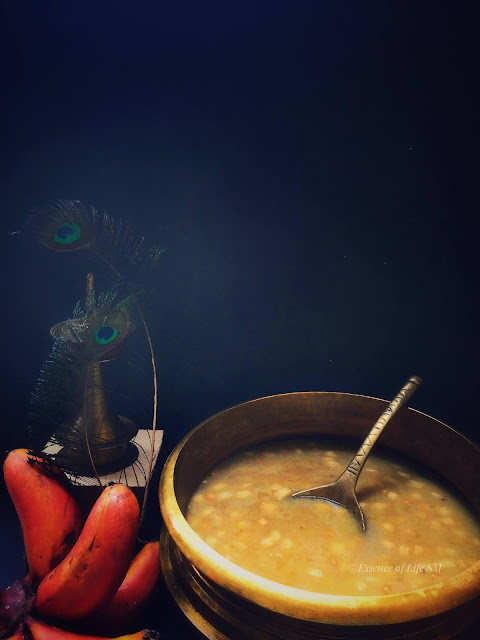
Kadali Pazha Pradhaman in a brass bowl with ripe red bananas and a decorative peacock feather in the background.

Traditional Kadali Pazha Pradhaman Recipe – Rice & Red Banana Payasam


A Taste of Tradition: Kadhali Pazha Pradhaman Recipe

Fond Memories of Kerala Weddings

    When it comes to payasam or pradhaman, I’m transported back to the joyous weddings at my parents' home. The main debate was always whether the wedding feast would feature Vella (white) Payasam or Karuppu (black) Payasam, or perhaps both. These were the days when weddings were celebrated in the front yard of your ancestral home (Tharavadu), adorned with traditional decorations and a small pandhal (canopy) made from coconut fronds.

The Traditional Wedding Preparations

    Before the wedding day, preparations would commence with sourcing bamboo poles and coconut fronds for the Pandhal. The community would come together, weaving coconut fronds and tying them to the poles with skilful hands—no ropes needed, just the fronds themselves.  Those were the days the culture of Shamiyana (canopies made out of cloth) hadn't seeped in.

    In the bustling household kitchen, activities were in full swing. Tea, snacks, and lunch were prepared for the crowd of family, friends, and neighbours who filled the house with lively chatter. The large vats required for cooking, known as Sadhya Vattom—huge urulis, charakku (bronze pots), ladles, woks, and coconut graters—were sourced from the neighbourhood. These traditional bronze vats are not just cooking vessels but also add a decorative touch to modern homes.   


The Night Before the Wedding

    The night before the wedding was marked by a harmonious buzz of activity. With catering services then a rarity, the preparation of the Sadhya (traditional feast) involved a collective effort. Vegetables were procured, some from the neighbours' farms. The night before the wedding, neighbours, friends, and family would bring along a few urulis, utensils, ladles etc., for cooking, as well as kitchen knives and coconut graters (cherava) from their homes. This unspoken tradition ensured there were enough utensils and tools for cooking, cutting, and grating, reflecting a sense of camaraderie and communal support. These contributions were never explicitly requested, but were always anticipated, making the cooking tasks smoother and more manageable.The cooking scene gets vibrant, with men handling most of the cooking tasks, while women took on smaller chores and enjoyed some gossip.

    A head cook would oversee the event, delegating tasks such as grating coconuts—a crucial ingredient in any Kerala Sadhya. Vegetables were chopped, masalas were ground, and coconut milk (Idichu Pizhinju) was extracted. All this happened amidst fun, laughter, and the occasional sneaky drink (Minungal Paripadi). By early morning, the payasam/pradhaman would be ready, and the group eagerly anticipated the first hot cups of Choodu Payasam for a taste test.

Recreating the Tradition: Kadhali Pazha Pradhaman

    While preparing Kadhali Pazha Pradhaman, I couldn’t help but reminisce about those cherished times. Using my small bronze uruli, I found myself immersed in memories of the traditional Kerala wedding atmosphere.  I may not be able to come across such a scenario in future.  Although modern weddings and catering services have transformed the cultural landscape, and it's years since I attended a Kerala wedding. But the essence of these traditions lives on in every spoonful of such delicious dessert & in my memories.


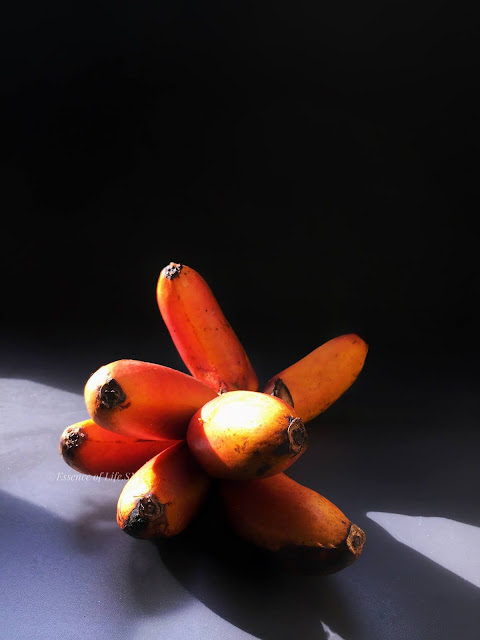
Close-up of ripe red bananas (Kadali), a key ingredient in the Kerala-style Kadali Pazha Pradhaman

Red Bananas (Kadali) – Key Ingredient for Kerala’s Unique Pradhaman

Kadhali Pazham: A Beloved Banana Variety

My Favourite Banana Variety

Kadhali Pazham, or Red Banana, holds a special place in my heart. Everyone in my family knows about my love for this particular banana variety. Whenever they spot Kadhali Pazham in the market, they make sure to buy a few just for me. My Dad and mother-in-law also keep some aside whenever I visit, knowing how much I cherish this fruit.

The Perfect Use for Excess Bananas

    Recently, my husband brought home a generous supply of Kadhali Pazham. Since I’m the only one in the household who enjoys this variety, I found myself with more bananas than I could eat. To make good use of them, I decided to prepare a classic Kadhali Pazham Pradhaman. This traditional dessert is made with raw rice and jaggery, and the aroma of ghee-roasted Kadhali Pazham makes it incredibly special and flavourful and best choice to serve for a Sadhya.

Why Kadhali Pazham Pradhaman Stands Out

    The ghee-roasted Kadhali Pazham adds a unique depth of flavour to the pradhaman, transforming it into a rich and delicious treat. The combination of the sweet, caramelized bananas with the earthy tones of jaggery and the smooth, nutty essence of ghee creates a dessert that is both aromatic and irresistibly tasty.


Cuisine - Kerala (India)
Recipe Type - Pradhaman/Payasam, Dessert
Difficulty - Medium
Serves - 4–6
Author - SM

Preparation Time - 15–25 Minutes
Cooking Time - 30–45 Minutes

For an extensive range of Sadhya Recipes, explore my blog - Essence of Life - Food


Step-by-Step Method to Make Kadhali Pazha Pradhaman


Kadali Pazha Pradhaman in a brass bowl with ripe red bananas and a decorative peacock feather in the background.
KADHALI PAZHA PRADHAMAN

Ingredients for Kadhali Pazha Pradhaman

To make this delectable Kadhali Pazha Pradhaman, you will need:

  • 3 tablespoons Ghee
  • 4 teaspoons Coconut Pieces
  • 3 Kadhali Pazham (medium-sized, ripe bananas)
  • 4 teaspoons Raw Rice
  • 1/2 cup Water
  • 1 1/2 cups Thick Coconut Milk
  • 1 1/2 cups Thin Coconut Milk
  • 3/4 cup Jaggery
  • 3-4 Cardamom Pods
  • 1/2 teaspoon Dry Ginger Powder (optional)

 
Close-up of Kadali Pazha Pradhaman in a bronze ladle, highlighting the texture with mashed red bananas, cooked rice, and coconut pieces

Close-Up of Kadali Pazha Pradhaman – A Rich Dessert with Red Bananas, Rice, and Coconut


Method for Making Kadhali Pazha Pradhaman

Preparing the Ingredients


  • Wash and Soak Raw Rice: Begin by washing the raw rice thoroughly. Soak it in water for 20–30 minutes to soften. After soaking, drain the rice and set it aside.
  • Prepare Jaggery: Melt 3/4 cup of jaggery in 1/2 cup of water. Strain the melted jaggery to remove any impurities and keep it aside.
  • Prepare Bananas: Peel and cut 3 medium-sized ripe Kadhali Pazham (red bananas) into small pieces. Alternatively, you can mash or grind the bananas for a smoother texture.
  • Cardamom Powder: Grind 3-4 cardamom pods with a few teaspoons of sugar to make a fine powder. Set this aside for later use.


Cooking the Pradhaman


  • Roast Coconut Pieces: Heat 3 tablespoons of ghee in a pan. Add 4 teaspoons of thinly sliced coconut pieces and roast them until they turn golden brown.   
  • Cook Bananas: Add the prepared bananas to the ghee. Cook on a low flame until the bananas become fragrant and slightly dry.  
  • Combine Ingredients: Add the soaked raw rice to the banana mixture, along with 1/2 cup of water and 1 1/2 cups of thin coconut milk. Cook the mixture on a low flame, stirring occasionally. Ensure the flame is low to prevent the rice from sticking to the bottom of the pan and burning.
  • Add Flavours: Once the rice is soft, stir in the cardamom powder and dry ginger powder (if using). Mix well.
  • Incorporate Jaggery: Pour the melted jaggery into the pan. Allow the mixture to boil gently on a very low flame for a few minutes.
  • Finish with Coconut Milk: Finally, add 1 1/2 cups of thick coconut milk to the pradhaman. Stir well and cook on a low flame for a few more minutes, stirring occasionally. 
  • Serve: Enjoy the Kadhali Pazha Pradhaman hot or cold, depending on your preference.


For a step-by-step guide on "How to make Coconut Milk", click here...


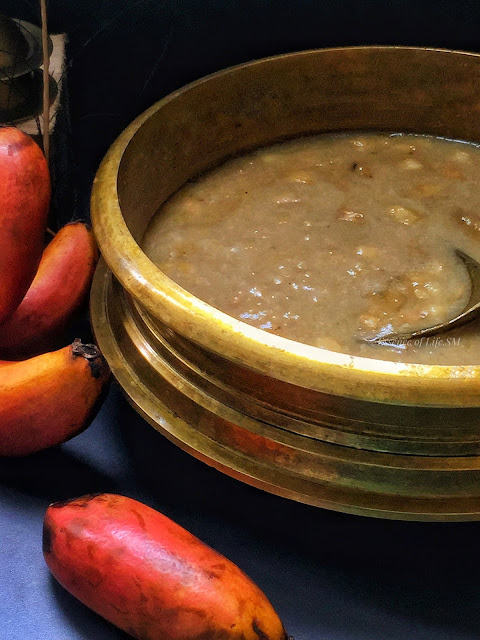
Close-up of Kadali Pazha Pradhaman in a bronze uruli, highlighting the texture with mashed red bananas, cooked rice, and coconut pieces with red bananas showcased in the background.

Close-Up of Kadali Pazha Pradhaman


Notes for Perfect Pradhaman

  • Rice Options: You can use Unakkalari (raw rice) for this recipe. Alternatively, cook the rice separately with thin coconut milk and then add it to the banana mixture.
  • Banana Preparation: You can cut the Kadhali Pazham into small pieces or mash it, depending on your texture preference. The same recipe can be made with Nendhra Banana for a different flavour.
  • Aroma and Flavour: Sautéing the mashed bananas in ghee adds a wonderful aroma and extra flavour to the pradhaman.
  • Consistency Adjustment: Adjust the consistency of the pradhaman to your liking. If you prefer a thicker or thinner consistency, modify the amount of coconut milk accordingly.
  • Sweetness Level: Kadhali Pazham adds natural sweetness to the dish. Adjust the amount of jaggery based on your taste preference.
  • Cooking Tips: Once you add the coconut milk, cook the pradhaman on a very low flame and stir occasionally to prevent curdling. Ensure that the flame remains low to avoid burning the rice and spoiling the taste.

Explore More Kerala Desserts

    If you enjoyed this Kadhali Pazham Pradhaman, you might also like these other delectable payasam, pradhaman, and kheer recipes:

  • Ada Pradhaman: A Classic Kerala Dessert
  • Paal Payasam: Creamy Rice Pudding
  • Kadumpayasam: Divine Offerings

Discover More on Payasam, Pradhamans, and Kheers

Looking for more sweet treats? Browse our collection of Payasam recipes:

  • Classic Payasam Recipes
  • Authentic Pradhaman Variations
  • Delicious Kheers for Every Occasion

 Reliving Cherished Memories with Kadhali Pazha Pradhaman

    Recreating traditional recipes like Kadhali Pazha Pradhaman not only honours these cherished memories but also connects us with our rich culinary heritage. As you make this delectable payasam, let the aroma and taste transport you to those simpler, joyful times.

   For more delicious and authentic recipes from Kerala and beyond, visit Essence of Life - Food and discover the true essence of traditional cooking!


PACHADI/KICHADI - SADHYA
PINEAPPLE PACHADI - KERALA STYLE

    Pachadi/Kichadi is a must-have item in the long list of side dishes served in a Kerala Sadhya or in a Vazhaiyilai Virundhu. A mixture of Raw vegetable or a fruit in Curd/Yogurt base, mildly seasoned to enhance the flavours.  Pineapple Pachadi is a simple, easy to cook recipe which can be prepared within minutes.  In this recipe, Pineapples are cooked along with Coconut Paste & Curd and tempered with mild spices. This is a quick recipe and can be added up into your long list of Sadhya Dishes.

    Pineapple Pachadi is a typical Kerala Dish, prepared with fresh or canned Pineapples.  It's best to use fresh pineapples, as they impart a wonderful flavour & the needed essence into this dish.  If you cannot get hold of fresh Pineapples, canned ones work best too.  Canned pineapples tend to get softer when cooked, so cook Canned pineapple briefly.

    When it comes to a Kerala Sadhya, Kichadi/Pachadi is a must-have item in the long list of dishes served in an elaborate Banquet or the so-called Sadhya.  Pineapple Pachadi or Kaithachakka Pachadi has taken a special place in Kerala Sadhya due to its mild sweet nature, it naturally imparts into the dish.  Overall, a Kerala Sadhya is served with dishes prepared to balance all taste notes & keeps in mind the ability to digest the food after an elaborate meal.  Not to spare this dish for a Sadhya alone, when you are in the mood for something tantalizing, this Pineapple Pachadi is sure to appease your taste buds.  For a simple Lunch Menu serve this Pineapple Pachadi with Rice.   


For more recipes for SADHYA, click here...

Cuisine - Kerala(South India)
Course - Side dish
Spice Level - Low
Difficulty - Easy
Serves - 3 - 4
Author - SM

Preparation Time - 5 Minutes
Cooking Time - 10-15 Minutes


For more Recipes FROM GODS OWN COUNTRY - KERALA, click here...


HOW TO MAKE PINEAPPLE PACHADI - KERALA STYLE

PACHADI/KICHADI - SADHYA
PINEAPPLE PACHADI - KERALA STYLE

INGREDIENTS:

For Pineapple Pachadi:

Pineapple - 11/2 Cups
Turmeric Powder - 1/4 Tspn
Salt - To Taste
Sugar - a Pinch
Thick Curd - 3/4 Cup  

To Grind:

Coconut - 1/4 Cup
Green Chillies - 1 Nos.  
Mustard Seeds - 1/4 Tspn

To Temper :

Coconut Oil - 1 Tbspn
Mustard Seeds - 1/2 Tspn
Fenugreek Seeds - 1/8 Tspn
Dry Red Chillies - 1 No.
Curry leaves - 2 Sprigs


For more PACHADI/KICHADI RECIPES, Click here...


METHOD:

  • Cut Pineapple into small cubes.
  • Cook the cubed Pineapples along with Turmeric & a dash of Salt until soft.
  • Meanwhile, grind the ingredients mentioned under "To Grind" into a fine paste.
  • Pour the ground Coconut paste to the cooked Pineapples and give a quick stir.
  • Cook this on a low flame until the raw flavour goes.
  • Whisk the Curd and pour it to the above.
  • Cook this on a very low flame for a few minutes stirring continuously.
  • Otherwise, the curd may curdle making the Pachadi watery.
  • Adjust the Salt and add a Pinch of Sugar and mix well.
  • Switch off the flame.
  • Heat Coconut Oil in a separate pan, splutter Mustard Seeds, Fenugreek Seeds, Dry Red Chillies and Curry Leaves.
  • Pour the tempering over the Pineapple Pachadi and mix well.
  • Serve Pineapple Pachadi with rice or serve it as one of the side dishes for Kerala Sadhya/Vazhaiyilai Virundhu.

NOTES:

  • I have used Yellow Mustard Seeds while grinding the Coconut Paste.
  • Adding Fenugreek is totally optional.
  • Once you add Curd make sure to cook the Pachadi on a very low flame for a few minutes stirring continuously.
  • Otherwise, the curd may curdle making the Pachadi watery.
  • Even if you are reheating the Pachadi, reheat it on a low flame, stirring it all the while.
  • Can use any cooking oil for tempering. But Coconut Oil gives an authentic flavour to the dish.
  • Pour the tempering over the Pineapple Pachadi. 


PICKLES
APPLE THOKKU - APPLE PICKLE

     If you are a fan of Pickles like me, then this Apple Pickle or Apple Thokku is for you. I am so fascinated myself to try out different types of Pickles & anything in the name of Pickles. This is a spicy, tangy pickle prepared with grated Apples.  Apples suit best to be prepared into a Thokku style Pickle.  With its mild sweetness Apple Thokku is sure to tantalize your taste buds.  

    When you have loads of Apple, pickling it is one best way to use it up.  Look, who's saying this. As a Pickle lover, I may end up saying this for anything & everything.  I can see brows lifting.  Knowing me personally and if you have seen my refrigerator with lines & lines of home-made Pickles in all genres.  You can clearly understand my craze for Pickles.  As my pickle lore goes, I eat pickle as a side dish (a whole-lot) with every meal.  When it is a home-made Pickle, I can be careful enough not to add too much Salt & Oil in to it & all the time I keep the Pickles refrigerated.  And I make only a small batch at a time.  This way I am getting rid of my Guilt (I am sure I don't have any!!!) & sceptical(ANGRY BIRD) look from my daughter.

    Apple Thokku recipe is quite similar to Mango Thokku recipe.  I have just replaced Apples for Raw Mangoes & have used Red Apples in this recipe. Can use Green Apples too. Tart or Sour Apples, suits best for the recipe. Apple Thokku though it may seem to be an out-of-the-box recipe, it is certain to appease your taste buds with its spiciness, tanginess & with a mild note of sweetness.  Combine it up with Curd Rice for an utter delicacy.


For more PICKLE Recipes, Click here...


Cuisine - Tamil Nadu (Indian)
Recipe Type - Pickle
Spice Level  - High
Difficulty - Easy
Yields - 21/ 2-3Cups
Author - SM

Preparation Time - 15 - 30 Minutes
Cooking Time - 8-10 Minutes
Maturing Time - Immediate


For THOKKU STYLE PICKLES, Click here...


HOW TO MAKE APPLE THOKKU - RED APPLE PICKLE

PICKLES
APPLE THOKKU - APPLE PICKLE

INGREDIENTS:

For Apple Thokku:

Red Apple - 3 Cups
Gingelly Oil - 1/2 Cup
Mustard Seeds - 1/2 Tspn
Curry Leaves - a Sprig
Turmeric Powder - 1/2 Tspn
Red Chilli Powder - 2-3 Tbspn
Asafoetida - 3/4 Tspn
Tamarind Paste - 1 Tspn
Salt - To Taste
Jaggery - a small Piece

To Dry Roast & Grind:

Fenugreek Seeds - 1/2 Tspn. 

PICKLES
APPLE THOKKU - APPLE PICKLE

METHOD:

  • Dry roast the Fenugreek Seeds on a very low flame until it splutters.
  • Cool and powder it.
  • Wash, Peel and grate the Apples and keep it aside(use them immediately).
  • Heat the Sesame Oil in a pan.
  • Splutter the Mustard Seeds, lower the flame, then add Asafoetida Powder and Curry Leaves.
  • Immediately add the grated Apples and sauté it on a low flame until it becomes soft & translucent.
  • Add Salt, Turmeric Powder, Red Chilli Powder, roasted Fenugreek Powder, to the above and mix well.
  • Add Tamarind Paste to the above and give a quick stir.
  • Add Jaggery to the above.
  • Cook this is on a low flame until oil separates from the pickle.
  • Switch off the flame and allow the Red Apple Thokku to cool down.
  • Store it in clean & dry airtight bottles.
PICKLES
APPLE THOKKU - APPLE PICKLE

NOTES:

  • Adjust the amount of Salt and Chilli powder as per your taste preference.
  • Pour some extra oil if you feel Apple Thokku is dry.
  • More oil, more storage period. 
  • Dry roasting the fenugreek seeds helps to preserve the pickle as well as gives a nice flavour.
  • Jaggery gives a slight sweetness to the pickle and also balances the sourness. (adding it is truly optional).
  • Avoid using steel/aluminium/copper containers for storing the pickles, as they tend to react with the acidic nature of salt and the Tamarind in the Pickle.
  • Store the Apple Thokku in clean and dry Porcelain/Glass/Ceramic Jars.
  • Always use clean & dry spoons(preferably wooden spoons) for the pickle.
  • Wet Jars/spoons can spoil the pickles as the moisture in them helps in the growth of Fungus.
  • If you feel that extra oil should be added, once the pickle is made, Heat the Sesame Oil, cool it and then pour it over the pickle.
  • Allow it to cool completely before storing it into sterilized bottles. 
  • Refrigerate the Apple Thokku.  It can stay good even with less oil and preservatives. 
  • If stored properly, Apple Thokku can last for about 2-3 Months.

MASAL VADAI/PARUPPU VADAI
TEA KADAI MASAL VADAI

    What is the difference between a Paruppu Vadai & a Masal Vadai?  I have always thought that both were the same.  But my premonition changed in my later years.  It was my husband who cleared my doubts, but he wasn't sure about the difference in the ingredients added into a Paruppu Vadai or a Masal Vadai. But I have always wondered when a wonderful aroma unique to Vadais emanate from the street side Tea Kadais.  Tea Kadais(stalls) have some secret ingredient or a trick which literally makes Vadais aromatic, crisp & tasty.

    Long forgotten and left alone with the so-called Tea Kadai Oosi Pona(stale) Vadais & the Kaakka(Crow) Story popularized by Actor-comedian Vivek.  I never ever gave a second thought towards this recipe.  But when I saw a video of Masal Vadai recipe by Mrs.Revathy Shanmugam, I immediately got into action.  And revelations of the ingredients what makes it unique and out of the box idea of the addition of spices like Cinnamon, Fennel Seeds and herbs like Mint & Coriander impressed me to the core. And I knew even before making it that it's going to be as good as a Tea Kadai Masal Vadai.  And it proved damn true to the lore.

    What's special about this recipe from Revathy Shanmugam is, it is down to earth as the person herself.  And the catchy explanations she gives about buying a Vadai or two from the roadside Tea Kadai, to eat it as a side dish for a packed lunch and the smell of Masal Vadais emanating from the tea shop made me feel too close to my heart & thoughts. Along with her simple tricks to get Vadais crispy also helped me get perfect Tea Kadai Masal Vadais.  Now, I don't have to wait to be in CBE, to get a good bite of Tea Kadai Masal Vadai.

     Vadais are commonly prepared with a variety of Lentils.  Paruppu Vadai as its name mentions is made with Bengal Gram Dhal and a small mixture of other Dhals  What makes Masal Vadai unique from Paruppu Vadai is the addition of aromatic spices & herbs in it. Some recipes even call for using Peas Paruppu(Yellow Split Peas) instead of Bengal Gram Dhal while making Masal Vadai. It is commonly seasoned with Onions, Green Chillies & deep-fried until crisp.  Masal Vadai mark its popularity due to their mild flavour from the lentils, with an extra note of spices & herbs and its excellent crispy texture. Masal Vadai goes well with Coconut Chutney. 

    It is one default street side snack sold in most of the roadside Tea Stalls, eateries & restaurants in South India & we can see a number of Mamak Shops & Indian Curry Houses in Malaysia & Singapore selling these Vadais.  Masal Vadai serves best as a Tea Time Snack, hot & crispy Masal Vadai with a hot cup of Coffee/Tea is one best thing on a rainy day. Or simply serve it as a side dish for Lunch- one best combination to go along with Rice & Sambar/Rasam/Curd. Masal Vadai serves best to be served as one dish in an elaborate Vazhaiyilai Virundhu.

For more VADAI RECIPES, Click here...


Cuisine - South Indian
Recipe Type - Snacks
Spice Level  - Low- Medium
Difficulty - Easy
Yields - 20 -25 Masal Vadais
Author - SM

Preparation Time - 5-10 Minutes.
Soaking Time - 1-11/2 Hours.
Cooking Time - 15-20 Minutes.


HOW TO MAKE TEA KADAI MASAL VADAI

MASAL VADAI/PARUPPU VADAI
TEA KADAI MASAL VADAI


INGREDIENTS :

Bengal Gram Dhal - 1 Cup
Dry Red Chillies - 2 Nos.
Cinnamon - 1 cm Piece
Fennel Seeds - 1/2 Tspn
Asafoetida - A Pinch
Onions - 2 Nos.
Garlic - 2-3 Cloves
Green Chillies -2 Nos.
Curry Leaves - 1 Sprig
Coriander Leaves - Few
Mint Leaves - Few
Salt - To Taste
Oil - For Deep Frying


METHOD:

  • Wash and Soak Bengal Gram Dhal for 1-11/2 Hours.
  • Drain the after 11/2 hours and leave the dhal in colander for a few minutes to drain well.
  • Remove a handful of soaked Bengal Gram Dhal & keep is aside. 
  • Then grind it along with Dry Chillies, Cinnamon, Fennel Seeds and Asafoetida.
  • Grind it into a coarse mixture.
  • Add a few teaspoons of water, if needed(while grinding).
  • Crush the Garlic pods with skin on & leave it aside.
  • To the ground mixture, add finely chopped Onions, Green Chillies, Curry Leaves & crushed Garlic Pods.
  • Add finely chopped Mint Leaves and Coriander Leaves.
  • Now add the soaked Bengal Gram Dhal(left aside) along with salt and mix well.
  • Heat oil in a pan.
  • Let the oil smoke off and then reduce the flame to medium-low.
  • Take lemon sized Masal Vadai mix and flatten them with your hands.
  • Drop the shaped Masal Vadai mix into the hot oil and deep-fry them on a medium-low flame until they turn into golden brown colour.
  • Drain the Masal Vadai on paper towels.
  • Serve Masal Vadai hot with Coconut Chutney or any other chutney of your choice.
  • Masal Vadai goes well along with hot-hot Coffee or Tea. 

 
MASAL VADAI/PARUPPU VADAI
TEA KADAI MASAL VADAI

NOTES:

  • Adding spices like Cinnamon & Fennel Seeds and herbs like Mint & Coriander leaves gives a wonderful aroma, flavour & taste unique to this Masal Vadai.
  • Adjust the amount of Spices to suit your spice level & preference.
  • Shallots adds an extra note taste to this Masal Vadai.  Can substitute Onions with Shallots.
  • Soak the Dhal for not more than 11/2 hours.
  • Soaking for a long time will make the Vadais absorb a lot of oil.
  • Drain the dhal and grind them into a coarse mixture, to yield crispy texture.
  • Deep fry the Masal Vadais on a medium-low flame until it turns into light golden brown in colour.
  • Deep frying on a medium flame also helps you get crispy Masal Vadais.


DHAL CURRY
ANDHRA STYLE TOMATO PAPPU


    Anything in the name of Paruppu is devoured heads down at home. Cooking a Curry with Dhal is as often a scenario at home & to give a mild twist or try new versions of curries with Dhal/Paruppu is something I love to do.  The list of dishes & curries prepared with Dhal is long enough, which gives a variety when it comes to daily cooking. When I saw this Andhra Style Dhal recipe, I was damn sure to give it a try & all the more it was a quick fix recipe prepared with Tuvar Dhal/Pigeon Pea Dhal  Though it looked quite similar to Thalicha Paruppu Recipe which is a family favourite, the spices used in Andhra Tomato Pappu with the addition of extra Tomatoes gave a wonderful flavour & taste. We call LENTIL/DHAL as Paruppu/Parippu in Tamil/Malayalam & the same is called as Pappu in Telugu.  As this recipe is cooked along with a good amount of Tomatoes, the recipe gets to be known as Tomato Pappu.

      Tomato Pappu served with piping hot Rice & a hearty drizzle of Ghee is an absolute treat. Combine it up with your choice of Stir-fries for a complete meal.  This Tomato Pappu is a traditional recipe from Andhra/Telangana prepared with Tuvar Dhal/Pigeon Pea Dhal.  Cooked Dhal is mashed & then it is mildly seasoned with Onions, Garlic & Tomatoes & then the dhal is tempered with spices which gives additional notes of flavours to this dish.

    I usually cook Dhal in a Pressure Cooker which makes the cooking faster. And all the more it is hassle-free & I feel lot more comfortable cooking Dhal in a Pressure Cooker.  Can soak the Tuvar Dhal for about 30 Minutes if you are cooking the Dhal in a regular Sauce Pan.  Soaking facilitates fast cooking and draining out the water used for soaking helps avoid the bloating caused by certain Pulses.  I have seasoned the cooked Tuvar Dhal first and then have cooked it for a few minutes which helps the flavours to get well infused into the Dhal before tempering the Tomato Pappu.


For more Recipes with DHAL, Click here...


Cuisine - South Indian
Course - Side Dish
Spice Level - Medium
Difficulty - Easy
Serves - 2 -3
Author - SM

Preparation Time - 5-10 Minutes
Cooking Time - 20-30 Minutes

For more Recipes from ANDHRA/TELANGANA CUISINE, Click here...


HOW TO COOK TOMATO TUVAR DHAL - ANDHRA STYLE TOMATO PAPPU

DHAL CURRY
ANDHRA STYLE TOMATO PAPPU

INGREDIENTS:

For Cooking the Dhal:

Tuvar Dhal - 1/2 Cup
Water - 2 Cups
Tamarind -  a small Piece 
Oil - 2 Teaspoons


To Sauté:

Oil - 2 Teaspoons
Mustard Seeds - 1/2 Teaspoon
Cumin Seeds - 1/4 Teaspoon
Shallots - 5-6 Nos.
Garlic - 2 Cloves
Green Chillies - 2-3 Nos.
Tomato - 2 Nos.
Water - 1/2 Cup
Salt - To Taste

For Final Tempering:

Ghee - 2 Teaspoons
Cumin Seeds - 1/2 Teaspoon
Fenugreek Seeds - 1/4 Teaspoon
Dry Red Chillies - 2 Nos.
Asafoetida - 1/8 Teaspoon
Curry Leaves - a Sprig
Turmeric Powder -  1/4 Teaspoon
Red Chilli Powder - 1/2 Teaspoon

For Garnishing:

Coriander Leaves


METHOD:

To Cook the Tuvar Dhal:

In a Sauce Pan:

  • Wash the Dhal twice or thrice or until water runs clear.
  • Soak Tuvar Dhal in ample of water for about 20-30 Minutes(Optional).
  • Once soaked drain & discard the water used for soaking.
  • Pour about 2 Cups of Water in a saucepan and allow it to boil.
  • Add 1/2 a cup of Tuvar Dhal along with a small piece of Tamarind to the water and give a quick stir.
  • Let it boil.
  • Once it starts to boil, reduce the flame and cover the saucepan.
  • Stir the Dhal occasionally and ensure that the Dhal is evenly cooked.
  • Can add more water if required.
  • Ensure that the Dhal doesn't get burnt at the bottom.
  • Once cooked, switch off the flame and keep it aside.
  • We need a slightly overcooked Dhal for this Tomato Pappu recipe.
  • Mash the Tuvar Dhal and keep it aside.

In a Pressure Cooker:

  • Wash the Dhal twice or thrice or until water runs clear.
  • Pour about 11/2 Cups of Water to 1/2 a cup of Tuvar Dhal.  
  • Add a small piece of Tamarind to the above and give a quick stir.
  • Place the bowl inside the Pressure Cooker.
  • Fix the gasket inside the lid and cover the pressure cooker.
  • Begin cooking under pressure over high heat for a Whistle or two.
  • Then lower the flame and cook for another 2 or 3 whistles.
  • Switch off the flame and wait for the pressure to release.
  • Once the pressure is totally released, open the lid and remove the bowl with cooked dhal from the pressure cooker.
  • Mash the Tuvar Dhal and keep it aside. 

For a detailed Recipe on HOW TO COOK BEANS, LENTILS & PULSES, Click here...
 

FOR TOMATO PAPPU:

DHAL CURRY
ANDHRA STYLE TOMATO PAPPU


For Seasoning the Dhal:

  • Wash the Garlic with skin on.
  • Pound the Garlic cloves slightly and keep it aside
  • Heat Oil in a Pan, splutter Mustard Seeds & Cumin Seeds(let the flame be at low).
  • Immediately add finely chopped Shallots, pound Garlic, Green Chillies slit into two and sauté until Shallots turn translucent.
  • Add finely chopped Tomatoes and sauté until tomatoes turn soft & cooked.
  • Cook on a low flame until oil separates from the mix.
  • Now add mashed Tuvar Dhal and give a quick stir.
  • Pour about 1/2 a cup of Water along with a dash of Salt.
  • Let it cook on a medium-low flame for about 7-10 Minutes.
  • Garnish the Dhal with finely chopped Coriander Leaves and immediately switch off the flame. 

For Tempering Tomato Pappu:

  • Heat Ghee in a separate Pan, splutter Cumin Seeds, Fenugreek Seeds, Dry Red Chillies & Curry Leaves in it.  Let the flame be at low.
  • Once the above ingredients have spluttered, switch off the flame and add Turmeric Powder, Red Chilli Powder & Asafoetida.
  • Give a quick stir and let it get roasted in the heat.
  • Pour the tempering into the Cooked Dhal and mix well.
  • Serve Tomato Pappu hot with Rice and a hearty drizzle of Ghee.

For HOME-MADE GHEE RECIPE, Click here...


NOTES:

  • Andhra Style Tomato Pappu is cooked with Tuvar Dhal/Pigeon Pea Dhal.
  • Can make the same recipe with Yellow Moong Dhal too.
  • Cook the Dhal accordingly.
  • Care should be taken while cooking Dhal in a Sauce Pan so that it doesn't get burnt at the bottom. Adjust the amount of water and cook accordingly.
  • Cook the Dhal well and mash it up before adding it along with the Seasoning or cook the Dhal Al dente to suit your preference.
  • Adjust the consistency of Tomato Pappu to suit your preference.

    SWEET COCONUT MILK
SWEET COCONUT MILK FOR APPAM/IDIYAPPAM

    I know two beautiful people who can write off their will for this heavenly Combo - Appam & Sweetened Coconut Milk.  One is my MIL and the other person is my friend Santhini.  I learnt that Santhini loves this combo during one of her visits.  I had made Appam, Chicken Curry & Stew.  But she asked whether I can make Sweetened Coconut Milk for her and serve Appam with Brown Sugar.  Since then, whenever possible I try to make this combo when she visits us.  Santhini, this is a long pending recipe for you.

    Appam being a frequented recipe at home and I often make a batch of Sweet Coconut Milk for me & my daughter too. What took me this long to post this recipe is to get it photographed. Here we go with the recipe of Easy-queasy Sweet Coconut Milk, one best combo which goes hand in hand with Appam & Idiyappam.  My first acquaintance with Sweet Coconut Milk was at Santhi Aunty's house.  She had served it with Idiyappam and the Sweet Coconut Milk was made with Jaggery & flavoured with Cardamoms.

    I usually make this Sweet Coconut Milk with Sugar and that is how my MIL usually makes & likes.  We can get easy when it comes to the sweetener -  Sugar/Jaggery/Palm Sugar.  The choice is yours. And I do not add Cardamom Powder or any other flavouring in Sweet Coconut Milk.  But traditionally the recipe calls for adding Cardamom Powder. 

    The only tedious process in making this recipe is grating, grinding & extracting the Coconut Milk.  Once the Coconut Milk is ready, the job gets easier.  Let's begin with the process, cracking the Coconut into beautiful and equal halves. (No... I cannot do it.  I have a great trouble in this feat that I need somebody to help me do this).  Lucky me, they sell it as grated coconut in local market.  So it is years I have tried to crack open a Coconut, scrap it etc., Well, talking about the tedious process - next feat is scrapping all that beautiful creamy soft flesh.  After this, the process turns out to be quicker.  Grind the grated Coconut in your food processor or a blender, squeeze and sieve it to yield creamy, thick Coconut Milk.  The freshness and flavour of home-made Coconut Milk is worth the process and all the more they have no additives in it. If you are using store-bought coconut milk or Coconut Milk Powder then you can get this recipe incorporated within no time.

For more APPAM RECIPES, Click here...


Cuisine - South Indian, Sri Lanka & Southeast Asian
Course - Side Dish
Difficulty - Easy
Yields - 11/2 Cups - 2 Cups
Author - SM


Preparation Time - 15-20 Minutes
Cooking Time - 8-10 Minutes


For IDIYAPPAM RECIPE, Click here...  


HOW TO MAKE SWEET COCONUT MILK FOR APPAM/IDIYAPPAM

 
SWEET COCONUT MILK
SWEET COCONUT MILK FOR APPAM/IDIYAPPAM
 

INGREDIENTS:

For Coconut Milk:

Grated Coconut - 11/2 Cups
Water - As Required.
A Sieve or a Thin Muslin Cloth
Blender or Food Processor

For Sweet Coconut Milk:

Coconut Milk - 11/2 Cups
Sugar/Jaggery/Palm Sugar - 1/2 Cup
Cardamom - 2-3 Pods(Optional)
Salt - a Pinch


METHOD:

For Coconut Milk: 

SWEET COCONUT MILK
SWEET COCONUT MILK FOR APPAM/IDIYAPPAM
  • Grate the coconut, measure & take 11/2 Cups of fresh coconut.
  • In a blender or food processor, add the grated coconut along with 1/2 cup of hot water and grind it for a minute. 
  • Can add 1 or 2 Pods of Cardamom while grinding the Coconut, if you want Cardamom flavour in the Sweet Coconut Milk.
  • Pour the ground mixture into a sieve or thin muslin cloth.
  • Squeeze out the milk from the ground coconut. This is the first extract which would be thick.
  • You get approximately 1/2 a cup of thick coconut milk from this.
  • Return the remaining coconut to the processor and add 3/4 cup of hot water.
  • Grind this for a few minutes.
  • Pour it into the sieve or muslin cloth and squeeze it for milk in a separate bowl. 
  • This gives you about 1/2 - 3/4 cup of thin coconut milk. This is the second extract.
  • Repeat the process if you need some more Coconut Milk.  The third extract would yield very thin Coconut Milk.
  • We do not need very thin Coconut Milk while making Sweet Coconut Milk.

For a detailed recipe on HOW TO MAKE COCONUT MILK, Click here...

If using canned Coconut Milk - 

  • Shake well and pour 1/2 of the content into a bowl and mix it along with 1/2 cup or required amount of water to make coconut milk.

If using Instant Coconut Milk Powder -

  • Mix 75 Grams of Instant Coconut Milk Powder with 150 ml of warm water & make coconut milk.


SWEET COCONUT MILK FOR APPAM/IDIYAPPAM: 

SWEET COCONUT MILK
SWEET COCONUT MILK FOR APPAM/IDIYAPPAM
 

For Sweet Coconut Milk with Sugar:

  • Mix Coconut Milk along with Sugar & a pinch of Salt.
  • Cook this on a low flame for a few minutes stirring continuously.
  • Cook until the Coconut Milk boils.
  • Switch off the flame.
  • Serve Sweet  Coconut Milk along with Appam/Idiyappam.
  • Can serve this Sweet Coconut Milk hot or @ room temperature.

For Sweet Coconut Milk with Jaggery/Palm Sugar:

  • Pour 1/2 Cup of Water to the Jaggery/Palm Sugar, boil this on high flame for a few minutes.
  • Lower the flame, boil it for about 5-6 minutes and strain for any impurities.
  • Mix melted Jaggery/Palm Sugar along with Coconut Milk & a Pinch of Sugar.
  • Cook this on a low flame for a few minutes stirring continuously.
  • Cook until the Coconut Milk boils.
  • Switch off the flame.
  • Serve Sweet  Coconut Milk along with Appam/Idiyappam.
  • Can serve this Sweet Coconut Milk hot or @ room temperature.

SWEET COCONUT MILK
SWEET COCONUT MILK FOR APPAM/IDIYAPPAM


NOTES:

  • Using hot water yields more coconut milk. Can use normal water too.
  • I use the 'extractor jar' in my Mixer Grinder to make coconut milk.  This helps me reduce the work.(squeezing through the sieve).
  • For a detailed recipe on HOW TO MAKE COCONUT MILK, Click here...
  • Can use Coconut Milk Powder or Canned Coconut Milk instead of fresh Coconut Milk for this recipe.
  • Adjust the amount of Sugar/Jaggery/Palm Sugar to suit your sweet preference.
  • Adjust the consistency of the Sweet Coconut Milk to suit your preference.


APPAM
KARIKKU APPAM - TENDER COCONUT APPAM

    Appam is one favourite dish among Malayalees.  Right from a Breakfast scene to an elaborate party scene you can see an Appam served in the menu.  So is the love for an Appam for Keralites.  Needless to say it serves as a default Breakfast Menu on a Christmas & Easter day, in most of the Kerala Christian Households.  Mostly served along with the ever knotted combo of Stew or an Egg Curry with Coconut Milk or any vegetarian/non-vegetarian side dishes of your choice.  Or simply serve it along with Red Coconut Chutney, sweetened Coconut Milk or with Sugar/Brown Sugar. Some even serve Appam along with Steamed Bananas/Nendhra Pazham Puzhungiyathu  The Side dishes served along with an Appam gets vivid with taste & preferences.

    When a region is overloaded with Coconut Trees & that's Our God's Own Country - Keralam, you are intended to find quite a number of dishes loaded with Coconuts whatsoever.  Needless to say, the locally proclaimed & celebrated hooch - the one & only "Kallu/Toddy" in the region and the never ending Kallu Shappu culture.  Even you can find a wonderful Appam made with Kallu or the Toddy called Kallappam or the Appam with fresh sweet Toddy.  Toddy helps in activating the fermentation process and also yields you with a fluffy centred and crispy edges Appams.

    This Karikku Appam recipe is a simple twist given to a Kallappam, where I have used Tender Coconut Shavings & Tender Coconut Water to make this Appam Batter.  And Yeast helps to get the batter fermented.  This is a foolproof recipe. It is one best way to use the tender & sweet Coconut shavings, and it is full of flavours. Tender Coconut shavings has a natural sweetness and adds a creamy, rich taste to this Karikku Appam. Allow the batter to ferment accordingly and there you go with a perfect Karikku Appam. This recipe of Karikku Appam yields you with  soft, fluffy centred and crispy edges Appams.

For more APPAM RECIPES, Click here...


Cuisine - South Indian, Sri Lanka & Southeast Asian
Course - Main Course
Difficulty - Medium
Yields - 30-35 Appams
Author - SM


Preparation Time - 15-20 Minutes
Soaking Time - 3-4 Hours
Fermentation Time - 10-12 Hours/Overnight

 
For more recipes from GODS OWN COUNTRY - KERALA  click here...  
 

HOW TO MAKE KARIKKU APPAM - TENDER COCONUT APPAM


APPAM
KARIKKU APPAM - TENDER COCONUT APPAM

INGREDIENTS:

To Grind:

Raw Rice  -  4 Cups
Cooked Rice  -  1 Cup
Tender Coconut Shavings -  3/4 Cup
Grated Coconut - 1/4 Cup
Tender Coconut Water - 3/4 Cup  
Water - as required
Salt  -  To Taste


For Yeast Mix :
Yeast  -  3 Tspns
Sugar  -  2 Tbspns
Water  -  1/4 Cup

METHOD :

Yeast Mix :  
  • Activate the yeast by adding lukewarm water & 2 Tbspns of Sugar.
  • Leave it aside until it ferments. (For about 15-20 Minutes)

For Karikku Appam Batter:
  • Wash & Soak the Raw Rice for about 3-4 hours.
  • Once soaked, drain the Rice.
  • Grind Raw Rice, Cooked Rice, grated Coconut and Tender Coconut shavings, adding little Coconut Water at a time.
  • Add water as required.
  • Grind it until it turns into a very smooth batter.
  • Add the Yeast Mix to the above batter.
  • Store it in an airtight container and leave it aside for another 10 - 12 hours or overnight to ferment.
  • Once fermented, add Salt and mix the batter well.

To make Karikku Appam/Tender Coconut Appam:

APPAM
KARIKKU APPAM - TENDER COCONUT APPAM


  • Heat the Appam pan.
  • Pour a ladle full of batter into the pan.
  • Swirl the pan once, in such a way that the batter spreads around.
  • The centre of the Karikku Appam/ Tender Coconut Appam should be slightly thicker than the edges.
  • Cover the pan with the lid and let it cook for around two minutes.
  • The flame should be kept at low.
  • Once the edges start to brown and the centre is cooked, the Karikku Appam/ Tender Coconut Appam is ready.
  • Remove the Karikku Appam from the pan.
  • Can serve with Stew, Red Coconut Chutney, Egg Curry with Coconut Milk or any Vegetarian/Non-vegetarian curry of your choice. 
  • Karikku Appam/ Tender Coconut Appam tastes great with sweetened Coconut Milk or simply serve it with Sugar/Brown Sugar.
  • Can also serve Steamed Bananas/Nendhra Pazham Puzhungiyathu/Nendhra Pazham cooked in Sugar Syrup along with Cloves as a side dish for Karikku Appam/ Tender Coconut Appam.

For more TIFFIN ITEMS, Click here ...

APPAM
KARIKKU APPAM - TENDER COCONUT APPAM


NOTES: 
  • I have used about 3/4 Cup of Tender Coconut Water while grinding the Batter.
  • If you need more water, can use Water/Tender Coconut Water for the purpose.
  • The Appam batter should be slightly thinner than the Dosa batter. 
  • Swirling the batter in the pan ONCE, yields crispy edges and soft, fluffy centres.
  • Activate the yeast in luke warm water. Do not use boiling water for the purpose. 
  • Adding Sugar to the Yeast Mix will speed up the activating process.
  • If you need to quicken the fermenting process, avoid adding Salt to the Karikku Appam/ Tender Coconut Appam batter.
  • Add Salt just before making Karikku Appam.
  • Fermentation time depends upon the weather.  Adjust accordingly.


Newer Posts Older Posts Home
Search Essence of Life - Food

I Me Myself

A vintage-style horizontal oval frame showcasing ornate silver spoons on a dark rustic surface

Essence of Life - Food is all about daily cooking with a simple sense of taste and health. It is all about food. Not a day goes by without eating for most of us, so what we eat matters on the whole. Food in the mode of goodness increases the duration of life, purifies one's existence, and gives strength, health, happiness, and satisfaction. Above all ingredients, the most vital one in my kitchen is love.

Sm @ Essence of Life - Food

Popular Posts

  • Kizhi Parotta: Kothu Parotta and Salna Wrapped in Banana Leaves
  • Madurai Mutton Chukka Varuval
  • Ragi Koozh Recipe (ராகி கூழ்) – Fermented Finger Millet Porridge
  • Brewing Authentic Malaysian Kopi: A Step-by-Step Guide to Mastering the Art of Kopi Making
  • How to Make Kerala Kanji | Traditional Rice Porridge with Payar, Chammanthi & Achar

Labels

AROUND THE WORLD BAKING BEVERAGES BIRIYANI & PULAO BREAKFAST CURRIES DESSERTS FROM GODS OWN COUNTRY From My Family's Kitchen - Heirloom Recipes GLOSSARY HOW TO... KERALA PALAHARAM KONGU CUISINE KUIH MUIH MALAYSIAN CUISINE MIDDLE EASTERN CUISINE Manvasanai - Flavours from Tamil Soil PICKLES RICE DISHES ROTIS SADHYA SNACKS & SAVOURIES SOUPS SPICE POWDERS TIFFIN ITEMS VIRUNDHU WINES eBook
Ebook - What I Cook - For Onam

Ebook - “What I Cook - For Onam”

Amazon.com/dp/B0CGPVY6J3

Indulge in Kerala’s Culinary Heritage: Traditional Onam Sadhya Recipes, with Expert Serving Tips! Celebrate Onam the authentic way! Discover 25 timeless Kerala Sadya recipes in my ebook. From avial to payasam, bring home the flavours of tradition. Available now on Amazon!

Essence of Life

Subscribe & Follow

© 2026 | Essence of Life - Food

  • Home
  • Ask First
    Please note that all rights for the photographs and texts on this blog, unless otherwise mentioned, rests with the author. Please do not use without permission.
  • Privacy Policy